Signs You Need a New Water Heater: 9 Warnings to Heed
I'm Dan Reeves, a licensed master plumber with 20 years in residential work and more than 4,000 jobs behind me. Water heaters almost never die silently. In the months before a tank lets go, it sends a series of increasingly blunt messages — noises, rust, shrinking showers, rising bills — and homeowners who answer those messages replace a heater on a Tuesday afternoon, on their own schedule, at a fair price. Homeowners who ignore them replace a heater on a flooded Sunday. Here are the nine signs I trust, what each one actually means, and the cost rule that settles repair-versus-replace without emotion.
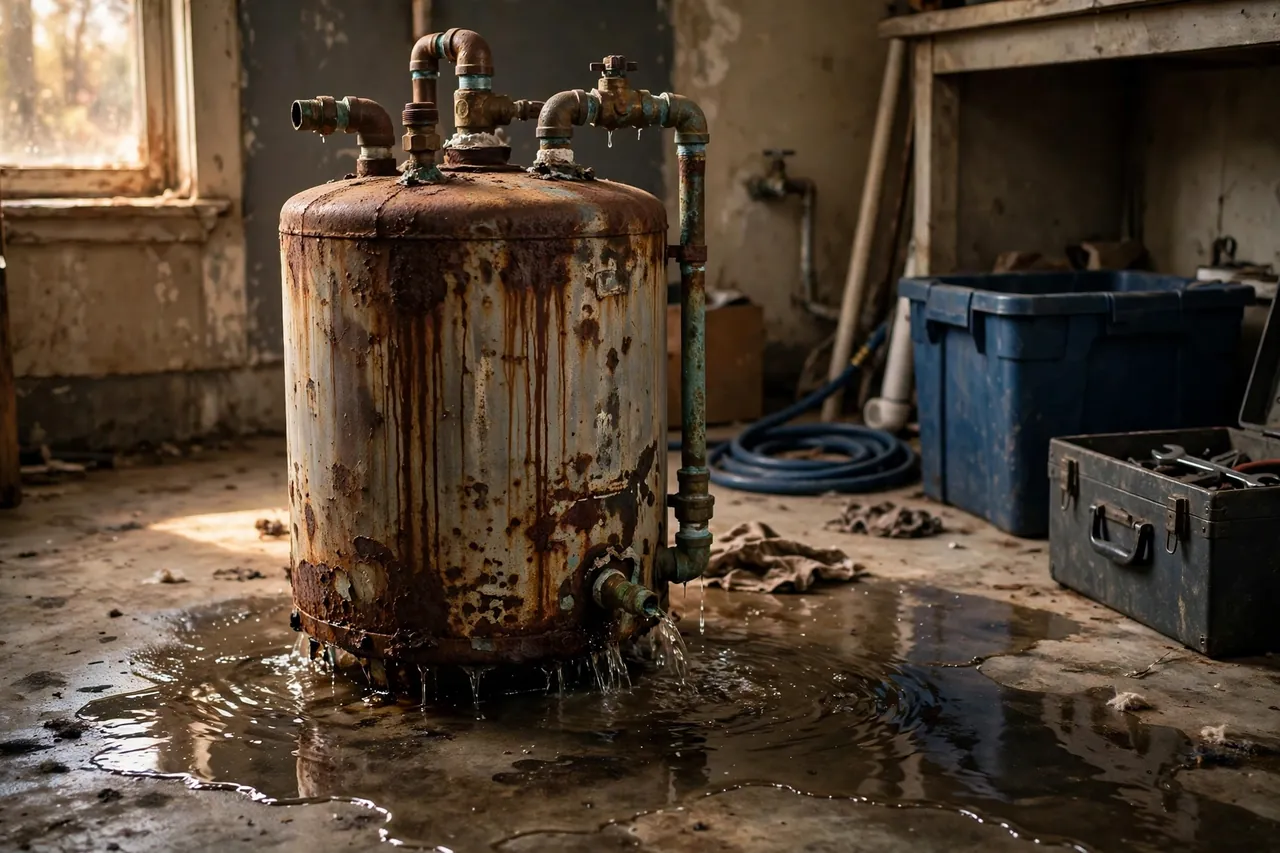
I’m Dan Reeves, a licensed master plumber with 20 years in residential work and more than 4,000 jobs behind me. Water heaters almost never die silently. In the months before a tank lets go, it sends a series of increasingly blunt messages — noises, rust, shrinking showers, rising bills — and homeowners who answer those messages replace a heater on a Tuesday afternoon, on their own schedule, at a fair price. Homeowners who ignore them replace a heater on a flooded Sunday. Here are the nine signs I trust, what each one actually means, and the cost rule that settles repair-versus-replace without emotion.
Quick answer: Replace, don’t repair, when the tank is leaking from its body, when hot water runs rusty on a unit over 8 years old, when the heater is past 10 to 12 years with any major symptom, or when a repair quote exceeds roughly half the $1,300 to $2,400 cost of a new installed tank — on an older unit, a quarter to a third is my real limit.
Which sign means repair, and which means replace?
| Sign | What it usually means | Verdict |
|---|---|---|
| Any leak from the tank body or base seam | Tank steel has corroded through | Replace — tanks cannot be patched |
| Rusty hot water only, heater 8+ years old | Anode rod gone, tank corroding | Replace in most cases; rod + flush only if younger |
| Rumbling, popping, banging | Hardened sediment layer on tank floor | Flush if young; replace if old and loud |
| Showers running cold sooner than they used to | Sediment stealing capacity, elements or burner struggling | Diagnose; age decides |
| Repair quotes stacking up year after year | Systemic end-of-life failures | Replace — the pattern is the diagnosis |
| Energy bills climbing with no other cause | Efficiency lost to sediment and worn parts | Weigh against the 50% rule below |
| Age 10–12 on a tank, even with no symptoms | Statistically at end of life | Plan replacement now, on your schedule |
| Water around the base that’s a fitting, not the tank | Valve or connection leak | Repair — this one is fixable |
| Pilot won’t stay lit / element keeps failing | Fuel or electrical component failing | Repair if young; replace if old |
What are the nine warning signs, one by one?
One: age. A tank water heater’s expected life is 8 to 12 years; tankless units run 15 to 20-plus, heat pumps 10 to 15. I detail the ranges by type in how long do water heaters last. Age alone is not a death sentence, but past 10 on a tank, every other sign on this list should be read as final.
Two: rusty or discolored hot water. If cold water runs clear and hot runs tea-colored or rusty, corrosion is happening inside the tank system. The early version of this story is a depleted anode rod — replaceable. The late version is the tank wall itself, and that one is not.
Three: leaks and moisture around the base. First, find the source honestly. A weeping drain valve, a dripping fitting, or a T&P valve discharging are repairs. Water seeping from the tank body or the bottom seam is a failed tank — I wrote the full triage in water heater leaking from bottom — and a failed tank leaks on its own schedule until it floods.
Four: rumbling, popping, and banging. Sediment bakes onto the tank floor, water trapped beneath it flashes to steam, and the tank starts sounding like a kettle full of gravel. On a young heater, a flush may save it. On an old one, that sediment has been insulating and overheating the steel for years, which is precisely what shortens tank life.
Five: running out of hot water. Sediment steals gallons of capacity and coats heating surfaces, so the shower that used to be fine now ends cold. Burners and elements also weaken with age. Either way, a heater that can no longer do its one job is telling you something.
Six: temperature swings. Scalding one minute, lukewarm the next points to failing controls or a heater at the edge of its ability to recover — annoying now, diagnostic gold combined with age.
Seven: rising energy bills. A heater fighting sediment and worn parts runs longer to do the same work. If usage is flat and the gas or electric bill creeps, the heater is a prime suspect.
Eight: repeated repairs. One repair is maintenance. Three service calls in two years is a pattern, and patterns at end of life do not reverse themselves.
Nine: visible corrosion on the tank and fittings. Rust streaks, crusty joints, and a jacket that looks tired are the outside of the tank confessing what the inside looks like.
How do you find your water heater’s age?
Every sign on this list gets sharper once you know the unit’s actual age, and the build date is printed on the rating label on the tank — you just have to decode it. Most manufacturers hide the date in the serial number rather than printing it plainly. The common patterns: Rheem and Ruud put the month and year in the first four digits of the serial (MMYY). Bradford White encodes the year in the first letter of the serial, cycling through the alphabet. AO Smith and State typically use a letter for the month followed by digits for the year, though the exact position varies by era. When the pattern is unclear, photograph the full label and search the manufacturer’s site for its serial decoder, or call their support line with the serial in hand — they will date it in a minute.
Write the year on the tank jacket in marker once you know it. Then the math of this whole article becomes a glance: a noisy 4-year-old tank gets a flush, a noisy 11-year-old tank gets a quote. I have dated hundreds of heaters this way standing in customers’ basements, and the number settles more arguments than any opinion I carry. Age is the one fact about your heater that never argues back.
How do you apply the 50 percent rule?
When the diagnosis is a repair rather than the tank body itself, do this arithmetic before approving anything. A new tank, installed, runs $1,300 to $2,400. If a repair quote exceeds about half that on a younger unit, replace instead. On a unit past 8 to 10 years, my threshold tightens to 25 to 30 percent, because the repaired tank’s remaining life is short — you are not buying years, you are renting months.
The exception that proves the rule: cheap, isolated parts on a sound tank. A thermostat, an element, or a T&P valve on a dry, clean, mid-life heater is a legitimate repair at almost any reasonable price. What the rule exists to kill is the $700 burner assembly on a rusting 11-year-old tank. That money is a down payment misdirected.
And if replacement wins, decide the next unit with clear eyes — including whether the household has changed enough to justify switching types. My comparison of tankless vs tank water heater walks the real trade-offs, and keeping the new heater alive starts with the water heater maintenance checklist I wish every homeowner followed from day one.
Can maintenance still save a heater showing early signs?
If the signs are sediment noise and shrinking capacity on a unit under 8 years old with no rust and no tank leaks — yes, sometimes. A flush, a fresh anode rod, and a valve test can return a neglected young heater to honest service, and that maintenance visit at $150 to $300 beats a premature replacement. What maintenance cannot do is un-rust a tank, un-thin corroded steel, or reset an age clock that has run out. The dividing line is the tank body’s integrity: sound tank, maintain it; breached tank, replace it. Everything else is detail. One practical habit falls out of this: when a pro does perform maintenance on a borderline unit, get the findings in writing — rod condition, sediment volume, any weeping at fittings. A written record turns next year’s decision from a fresh argument into a comparison, and it is exactly the documentation an insurer likes to see if a borderline tank ever does let go.
When should you call a pro about these signs?
Call the same week you find water at the base, rusty hot water on an older unit, or a tank past 10 years showing any new symptom. Call today if the tank is actively leaking — and close its cold supply valve and shut off its fuel or breaker while you wait, because a leaking tank’s favorite trick is becoming a flooding tank overnight. The entire point of this list is timing: a heater replaced on signs costs you a planned $1,300 to $2,400. A heater replaced on failure costs that plus the water damage. The tank has been sending messages. Answer them while they are still polite.
Frequently asked questions
At what age should you replace a water heater before it fails?
For a standard tank heater, I start the replacement conversation at 10 years and treat 12 as borrowed time, because a tank's expected life is 8 to 12 years and failures past that are usually leaks, which cannot be repaired. Tankless units earn a longer leash — 15 to 20-plus years — since their failure mode is usually a heat exchanger or control problem, not a flooded room. The smart move is planned replacement at the top of the age range while the old unit still works: you choose the timing, the model, and the installer instead of accepting whoever answers the phone on the worst weekend of the year.
Can rusty hot water be fixed without replacing the heater?
Sometimes — it depends on what is rusting. If the rod is consumed and corrosion is just starting, a new rod and flush can clear it on a mid-life tank, and I have done it with good results. But if the rust comes from the tank steel itself — the lining failed and the wall is corroding — no part fixes it, because the tank is the rust. The test is the rod: pull it, and if the tank is over 8 years old and the rod is bare wire, the verdict is replacement. Rusty water on a young tank with a healthy rod points elsewhere — usually the pipes.
How much does it cost to install a new water heater?
A like-for-like tank replacement, professionally installed, typically runs $1,300 to $2,400 in most markets — the unit itself is often $600 to $1,200 of that, with labor, permit, fittings, and disposal making up the rest. Tankless installations cost substantially more, commonly $2,500 to $4,500, because venting, gas sizing, and condensate work join the bill. Same-size, same-fuel swaps in an accessible spot land at the low end; moving the unit, upsizing, or converting fuel types pushes it up. Get two quotes if the job is not an emergency — and notice that planning ahead is what makes two quotes possible.
Is it worth repairing a 10-year-old water heater?
Usually not beyond the cheapest fixes, and here is the arithmetic I use. A repair should not exceed about 50 percent of replacement cost on any unit — and on a 10-year-old tank I tighten that to 25 to 30 percent, because a $1,300 to $2,400 replacement buys a new 8-to-12-year clock while a $500 repair buys an old tank with one new part. Exceptions exist: a failed thermostat or element on a clean, dry, well-maintained 10-year-old tank can be a reasonable small gamble. But money spent fighting leaks, rust, or repeated failures at that age is money donated to a tank that is leaving anyway.
What happens if you wait until a water heater bursts?
Forty to fifty gallons arrive in your utility room or basement all at once, and a tank that splits under pressure can keep feeding from the supply line until someone closes the valve. I have walked into basements with two inches of water across an entire floor from a tank that was 'making a little noise last month.' The damage bill — flooring, drywall, belongings, mold remediation — routinely exceeds the heater's own cost several times over, and it all happens on the tank's schedule, usually a weekend or a vacation. Every sign in this article is the tank asking to be replaced politely. A burst is it stopping asking.