Sewer Lining vs Pipe Bursting: Cost, Lifespan & Winner
Every homeowner with a failing sewer line eventually faces the same fork in the road: the crew can slide a new pipe inside the old one, or they can smash the old pipe apart and pull a brand-new one through its grave. Those are sewer lining and pipe bursting, the two trenchless methods, and choosing wrong costs real money. I am Dan Reeves, a licensed master plumber with 20 years and more than 4,000 jobs behind me. I have specified both methods hundreds of times, and the right answer is never about which technology is fancier. It is about what your camera footage shows.
Every homeowner with a failing sewer line eventually faces the same fork in the road: the crew can slide a new pipe inside the old one, or they can smash the old pipe apart and pull a brand-new one through its grave. Those are sewer lining and pipe bursting, the two trenchless methods, and choosing wrong costs real money. I am Dan Reeves, a licensed master plumber with 20 years and more than 4,000 jobs behind me. I have specified both methods hundreds of times, and the right answer is never about which technology is fancier. It is about what your camera footage shows.
Quick answer: Line the pipe when it is still round and passable but leaking, cracked, or root-filled — CIPP lining runs $80 to $250 per foot and lasts about 50 years. Burst the pipe when it is severely deteriorated, out of round, or undersized — bursting runs $60 to $200 per foot and installs new HDPE rated for 50 to 100 years. If the line has collapsed or holds a deep belly, neither trenchless method is honest; that line gets dug.
What is the actual difference between sewer lining and pipe bursting?
Both methods avoid the long open trench, and that is where the similarity ends.
Sewer lining (CIPP — cured-in-place pipe) builds a new pipe inside your old one. The crew cleans and cameras the line, then inverts or pulls in a flexible tube saturated with resin. The tube is pressed against the host pipe’s walls and cured with hot water, steam, or UV light until it hardens into a rigid, jointless pipe. Your old pipe stays in the ground as a shell around it. The result seals cracks, bridges small gaps, and eliminates the joints roots enter through — but it inherits the host pipe’s shape, diameter, and slope.
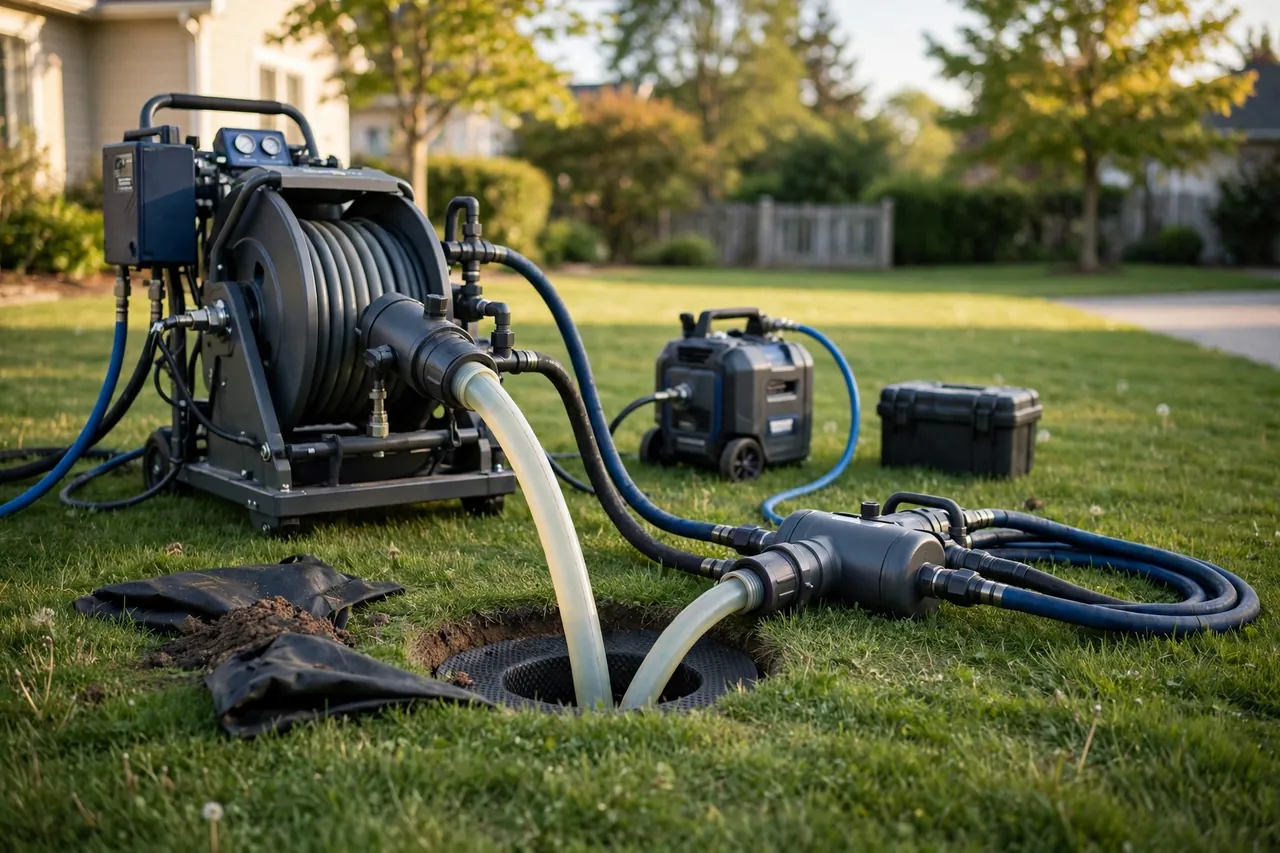
Pipe bursting replaces the pipe outright. The crew digs two small pits, feeds a steel cable through the old line, and attaches a bursting head followed by new HDPE pipe. A hydraulic puller draws the head through, fracturing the old pipe outward into the soil while the new pipe takes its exact path. The old pipe’s condition stops mattering the moment the head passes. The new pipe is a genuine new installation — and it can be the same size or one size larger than the original.
| Factor | CIPP sewer lining | Pipe bursting |
|---|---|---|
| What you end up with | New pipe inside the old pipe | Brand-new pipe, old one destroyed |
| Cost per foot | $80–$250 | $60–$200 |
| Typical residential total | $3,000–$20,000 | $3,500–$20,000 |
| Design lifespan | ~50 years | 50–100 years (HDPE) |
| Diameter outcome | Slightly smaller (~1/4 in lost) | Same size or upsized (4 in → 6 in possible) |
| Host pipe must be | Round, passable, holding its shape | Almost anything — clay, cast iron, PVC, Orangeburg |
| Handles collapse? | No | Sometimes, if partial |
| Handles a belly (sag)? | No — follows the sag | No — follows the same path |
| Access needed | Usually one point, often the cleanout | Two pits, roughly 3 ft × 3 ft each |
| Typical duration | 1 day + 4–6 hr cure | 1–2 days |
| Surface disturbance | Minimal | Two pits to patch |
How much does each method cost per foot?
The published national ranges overlap heavily, which surprises people. EngineerFix and Go Pro Plumbing both bracket CIPP lining at $80 to $250 per linear foot, and pipe bursting at $60 to $200 per linear foot. Angi’s 2026 data lands in the same place: $90 to $250 for lining, $60 to $200 for bursting. For a typical 50-foot residential line, either method usually totals somewhere between $4,000 and $10,000, with short, easy lining jobs occasionally closing near $3,000 and long or complicated jobs of either type pushing toward $20,000.
Where the totals diverge is everything around the pipe. Lining usually needs the least excavation — often none beyond a cleanout — so it protects driveways, slabs, and landscaping completely. Bursting trades two modest pits for the ability to handle worse pipe and upsize. Both methods undercut traditional digging most clearly on total project cost, because an open trench’s restoration bill — concrete, asphalt, landscaping — frequently rivals the pipe work itself. NuFlow’s published comparison puts trenchless savings at roughly 30 to 50 percent of the total project in surface-heavy situations. For the full per-foot picture including traditional replacement, see my sewer line replacement cost per foot guide.
One warning about low quotes in either method: the per-foot price should include cleaning, the before-and-after camera work, and reinstatement of any lateral connections. A liner quote that quietly excludes reinstating your branch connections is a quote for a job that leaves your side drains sealed shut.
Which one lasts longer?
Bursting wins this category on paper, and the reason is structural. A burst installation is a new HDPE pipe with no dependence on anything old. HDPE is rated at 50 to 100 years of service — EngineerFix brackets it at 50 to 100, and several manufacturers and trenchless guides cite 75-plus years under stable soil conditions. Nothing about the failed pipe can come back to haunt it.
A properly installed CIPP liner is a structural pipe in its own right, designed for about 50 years — NuFlow and most lining manufacturers state 50-plus, while EngineerFix’s more conservative bracket is 30 to 50. The honest caveat is installation quality. A liner that is undersaturated, poorly cured, or wrinkled at a bend can fail in 20 to 30 years, which is why the installer’s process and the post-installation camera footage matter more for lining than for almost any other plumbing work. The liner does not depend on the host pipe for strength once cured, but it does depend on the crew.
Practically: at 50-year horizons, both methods outlast most homeowners’ tenure in the house. Bursting’s lifespan edge is real but rarely the deciding factor. Condition and capacity decide first.
When is lining the right call?
Lining is my default trenchless recommendation when the camera shows a pipe that is structurally present but leaking: hairline and moderate cracks, joints offset slightly or infiltrated by roots, corrosion pitting in cast iron, and long runs with many small defects rather than one catastrophe. It is the best tool we have for lines running under things you cannot move — house slabs, additions, porches, stamped concrete, and mature landscaping — because it can often be installed entirely from a cleanout with zero digging.
Lining also wins on speed and disruption. One day of installation, a few hours of cure, and your yard never knows we were there. For a homeowner selling a house with a documented root problem at the joints, a lined pipe with after-footage and a warranty is frequently the fastest honest fix that satisfies a buyer’s inspector.
When is bursting the right call?
Bursting takes over where lining’s requirements fail. Choose it when the pipe is severely deteriorated or out of round — crushed Orangeburg, cast iron with sections missing, clay shattered at multiple joints — because the bursting head does not care what shape the old pipe is in. Choose it when you need more capacity: pulling a 6-inch line through a 4-inch path is routine for bursting and impossible for lining, and older homes tying into modern mains often benefit from exactly that upsize. Choose it when the host pipe is a patchwork of materials — clay to cast iron to ABS repairs — where a liner’s bond and shape would be inconsistent.
The price of those advantages is the two access pits and a slightly longer job. If your pipe qualifies for both methods, that small excavation is usually the only reason to hesitate.
When can neither trenchless method save you?
Both methods follow the existing pipe’s path, so both inherit its geometry. A line with a belly — a sag where water and solids pool — comes out of either process with the same sag. A fully collapsed section with soil intrusion stops a liner completely and usually stops a bursting head too. And a line that was installed with inadequate slope was never right in the first place; no trenchless method regrades it.
Those lines get dug, and anyone who tells you otherwise is selling you a 50-year liner in a pipe shape that will clog in five. The camera footage shows all of this plainly, which is why I keep returning to it: the inspection is not a formality before the real work. It is the decision. If you have not had one and your drains are misbehaving at several fixtures, start with the signs of a main sewer line clog and get the line filmed before you let anyone quote you a method.
When should you call a pro about lining versus bursting?
Call a trenchless contractor — ideally one who offers both methods and traditional digging — when a camera inspection has documented cracks, roots, or deterioration along your line. A company that only lines will find lining candidates; a company that only digs will find digging jobs. Bring the footage, the line’s length and depth, and ask the deciding questions directly: Is my pipe round and passable? Do I need capacity I do not have? What does each method cost on my line, in writing, including lateral reinstatement and the after-installation camera pass? The contractor who answers those three straight is the one whose 50-year promise I would trust.
Frequently asked questions
Is pipe bursting better than sewer lining?
Neither is better in general — they solve different failures. Lining is better when the host pipe is still round and structurally passable but leaks, cracks, or grows roots at the joints, especially under slabs and finished landscaping. Bursting is better when the pipe is severely deteriorated, out of round, or too small, because it installs a completely new pipe and can upsize the diameter. The camera footage of your line decides which one you are a candidate for. Any contractor who recommends one method before seeing footage is recommending the machine he owns.
Does sewer lining shrink your pipe's diameter?
Yes, slightly. A cured-in-place liner typically adds about a quarter inch of wall, so a 4-inch line becomes roughly 3.75 inches inside. In practice, flow is rarely affected, because the liner's surface is far smoother than the corroded clay or cast iron it replaces — a smooth 3.75-inch pipe often outflows a rough 4-inch one. The exception is a line that was already undersized or marginal for the home's fixture load. If capacity is your concern, that is an argument for pipe bursting, which can pull in a larger pipe than the original.
How long does sewer lining or pipe bursting take?
Most residential lining jobs install in one day, plus 4 to 6 hours of curing time for the resin, with service usually restored the same evening. Pipe bursting typically takes 1 to 2 days, including digging the entry and exit pits and pulling the new line through. Both are dramatically faster than open-trench replacement, which commonly runs 2 to 4 days of digging plus restoration time. Weather and groundwater can slow either trenchless method, but neither should keep your sewer out of service for more than about a day at a stretch.
Can a collapsed sewer line be lined or pipe burst?
A fully collapsed line cannot be lined — the liner needs a passable, roughly round host pipe to form against, and a collapse or a severe belly defeats it. Pipe bursting can sometimes handle a partially collapsed line, because the bursting head physically breaks the old pipe apart as it advances, but a total collapse with displaced soil often stops the pull. In those cases open-trench replacement is the honest answer. This is exactly why a camera inspection comes first: the difference between a lining candidate and a digging job is visible, not guessable.
Do sewer lining and pipe bursting come with warranties?
Reputable trenchless contractors warranty both, commonly 10 to 25 years on workmanship and materials for lining, and longer on burst installations since the result is a brand-new pipe. The design lives behind those warranties are much longer — about 50 years for a cured liner and 50 to 100 years for new HDPE. Read the warranty for what it actually covers: liner delamination and root intrusion at joints are the realistic lining claims, while bursting warranties mostly cover installation defects. Get the terms in writing before work starts, and keep the before-and-after camera footage with the paperwork.