Sewer Line Replacement Cost Per Foot: 2026 Price Guide
Of all the numbers in plumbing, the one homeowners ask me for most is a per-foot price for replacing a sewer line — and it is the number most easily used to mislead you. I am Dan Reeves, a licensed master plumber with 20 years and more than 4,000 jobs behind me. The honest national range for traditional sewer line replacement is **$60 to $250 per linear foot**, and trenchless methods run **$60 to $250 per foot** as well, depending on method. That spread is so wide it looks useless until you understand what moves a job inside it. This guide gives you the per-foot numbers, the totals they produce at real line lengths, and the factors — depth above all — that decide where your line lands.
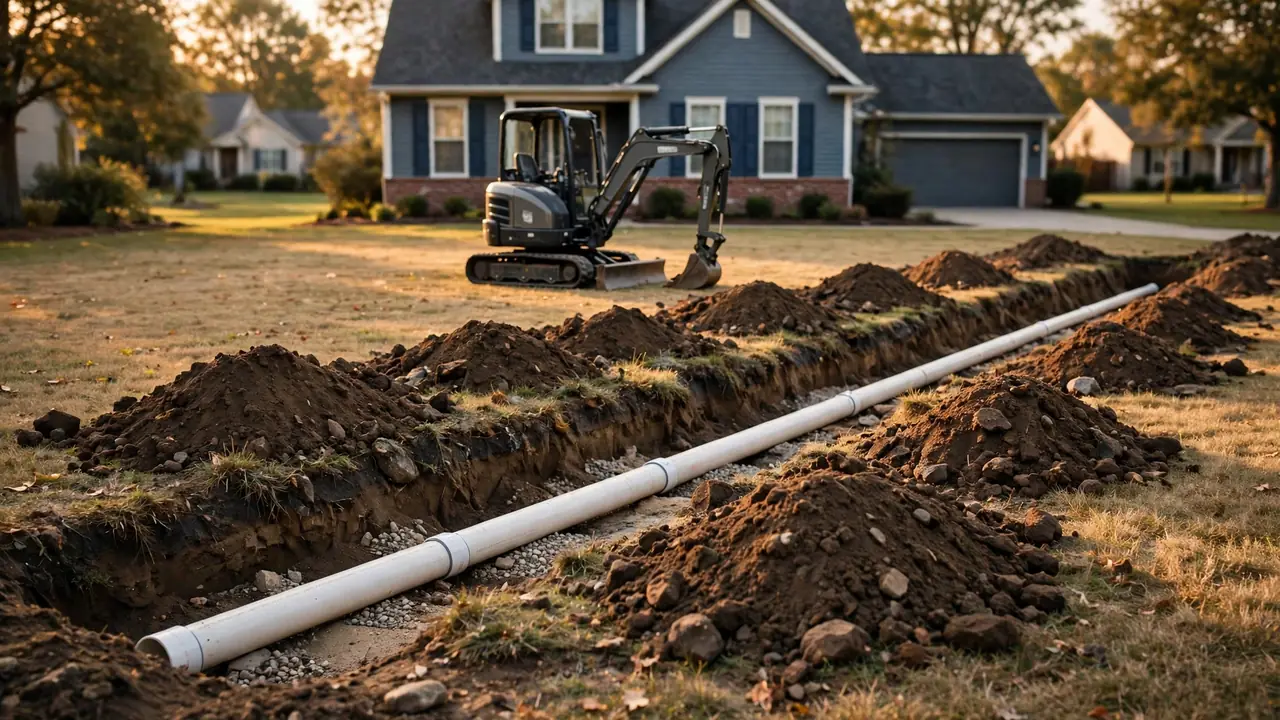
Of all the numbers in plumbing, the one homeowners ask me for most is a per-foot price for replacing a sewer line — and it is the number most easily used to mislead you. I am Dan Reeves, a licensed master plumber with 20 years and more than 4,000 jobs behind me. The honest national range for traditional sewer line replacement is $60 to $250 per linear foot, and trenchless methods run $60 to $250 per foot as well, depending on method. That spread is so wide it looks useless until you understand what moves a job inside it. This guide gives you the per-foot numbers, the totals they produce at real line lengths, and the factors — depth above all — that decide where your line lands.
Quick answer: Budget $60 to $250 per foot for a traditional dig-and-replace, $90 to $250 per foot for CIPP lining, and $60 to $200 per foot for pipe bursting (Angi’s 2026 national data). A typical 40 to 60 foot house-to-street line therefore totals roughly $3,000 to $15,000, with most straightforward lawn runs landing $5,000 to $9,000. Every extra foot of depth, and every driveway or slab the line crosses, pushes you toward the top.
What is the average sewer line replacement cost per foot?
Here is the per-foot landscape from Angi’s 2026 cost data, cross-checked against NuFlow’s published trenchless comparison and national cost guides:
| Method | Cost per linear foot | What drives it within the range |
|---|---|---|
| Traditional open-trench replacement | $60–$250 | Depth, soil, surface restoration |
| Partial replacement (short section) | ~$50 and up | Mobilization dominates on tiny jobs |
| CIPP sewer lining (trenchless) | $90–$250 | Length, diameter, lateral reinstatements |
| Pipe bursting (trenchless) | $60–$200 | Soil conditions, pit access, upsizing |
| Excavation alone (labor component) | $50–$200 | Depth and soil type |
| Section under a concrete slab | Add $300–$350 per foot | Saw-cutting, removal, repour |
Two things surprise people in that table. First, trenchless is not automatically cheaper per foot — lining often prices at or above digging on a pure per-foot basis, and earns its money by avoiding restoration, which I get to below. Second, the pipe itself is almost the cheapest part of the job. PVC or HDPE pipe costs a few dollars a foot. You are paying for excavation, labor, equipment, permits, and putting your property back together. That is why two 50-foot lines on the same street can be $4,000 apart with both plumbers charging fairly.
If you are not sure your line actually needs replacement rather than repair, start with the signs of a main sewer line clog and get a camera inspection, typically $100 to $500, before you price anything. Every honest number in this guide assumes somebody has seen the inside of your pipe.
What does the total come to at real line lengths?
Per-foot numbers only matter once you multiply them by your run. Most residential laterals run 40 to 60 feet from the house to the street connection, but I have replaced 25-foot lines on tight city lots and 110-foot lines on flagged rural properties. Here is what the traditional dig range produces:
| Line length | Traditional replacement total at $60–$250/ft | Typical landing zone, straightforward lawn run |
|---|---|---|
| 30 feet | $1,800–$7,500 | $2,500–$5,000 |
| 40 feet | $2,400–$10,000 | $4,000–$7,000 |
| 50 feet | $3,000–$12,500 | $5,000–$9,000 |
| 60 feet | $3,600–$15,000 | $6,000–$10,500 |
| 80 feet | $4,800–$20,000 | $8,000–$14,000 |
| 100 feet | $6,000–$25,000 | $10,000–$17,000 |
NuFlow’s published comparison brackets a 40 to 60 foot traditional replacement at $8,000 to $20,000 or more once restoration is fully counted, which lines up with the upper half of this table — that is the version of the job where the trench crosses things you care about. The “typical landing zone” column is the same job over plain lawn at moderate depth. Both are real. The difference between them is not the plumber. It is what sits on top of your pipe.
Measure your run before you collect quotes. The distance from your house cleanout to the street, plus the depth at the connection, tells an estimator more than any other two facts. A contractor who quotes without asking either one is guessing at your expense.
How does depth change the price per foot?
Depth is the single biggest cost driver in sewer work, and it is the one homeowners cannot see from the surface.
A line buried 3 to 4 feet down is a mini-excavator job: one operator, a laborer, spoil piled beside the trench, done. At 6 to 8 feet, the trench walls need benching or shoring for safety, the hole is wider at the top, the machine is bigger, and every bucket of dirt travels farther. Past 8 feet you are in engineered-shoring territory with a larger crew, and the per-foot price climbs steeply. Angi’s data puts excavation alone at $50 to $200 per linear foot depending on soil and depth — meaning on a deep line, the digging can cost more than everything else combined.
Depth also explains the geography of prices. Northern homes with deep frost lines bury sewers deeper than southern homes, and older city lines often sit deeper than the tapped connection expects. When you compare quotes, make each bidder state the assumed depth in writing. A low per-foot quote built on a 4-foot assumption becomes a change order the day the trench hits 7 feet.
Soil rides along with depth. Sand and loam dig fast. Rock, caliche, and heavy clay slow the machine and the crew, and groundwater in the trench means pumps and bedding work. None of that is upselling — it is physics with an invoice attached.
How do pipe material and size affect the cost?
Less than homeowners expect, but not zero. Standard residential laterals are 4-inch pipe; some older homes run 3-inch or 6-inch. Moving up a diameter adds a modest amount per foot in material and can matter for trenchless work, where upsizing during pipe bursting is one of that method’s real advantages.
For the new pipe itself, PVC is the default for open-trench replacement — cheap, durable, and root-resistant at the joints when properly bedded. HDPE is the standard pull-in material for bursting. Cast iron still gets specified in some jurisdictions and for certain commercial-adjacent runs, and it costs more in both material and handling. The host pipe’s material matters more for method selection than for price: clay, cast iron, and Orangeburg lines all fail differently, and the camera footage of what is in the ground decides whether lining is even possible. I compare the two trenchless methods head to head in sewer lining vs pipe bursting.
What is usually missing from a per-foot quote?
This is the section that saves people money. A bare per-foot figure often excludes:
- Surface restoration. Lawn repair might be a few hundred dollars. A torn-out driveway section, sidewalk panels, or mature landscaping can add $3,000 to $8,000 on a 40-foot run. Ask whether restoration is in the number or on top of it.
- Concrete slab sections. Angi puts work under a slab at an additional $300 to $350 per foot for that stretch — saw-cutting, hauling, and repouring are their own trade job inside your plumbing job.
- Permits and inspection fees. Typically a few hundred dollars, and required in nearly every jurisdiction for a lateral replacement.
- Camera inspection before and after. $100 to $500 if not bundled. The before footage justifies the scope; the after footage proves the work.
- City connection and street work. If your line runs to a main under the street, traffic control, street cutting, and repaving can apply, sometimes with city fees on top.
Add those up honestly and the per-foot number you were quoted may only be 60 percent of your real total. A total-project quote that lists these items separately is not more expensive — it is just more honest, and it is the only kind I sign.
When does trenchless beat the per-foot dig price?
On the per-foot line alone, trenchless methods overlap traditional digging almost completely — $80 to $200 per foot is a fair summary band for both lining and bursting once you blend the published ranges. Trenchless wins on the total when the surface above the pipe is valuable: finished landscaping, a stamped driveway, a slab, a porch, a mature tree you intend to keep. NuFlow’s comparison estimates 30 to 50 percent total project savings in hardscape-heavy situations, and that matches what I see — the savings are restoration you never have to buy.
Trenchless also wins on the calendar. Most lining and bursting jobs finish in 1 to 2 days against 2 to 4 or more for an open trench, and your yard is not a construction zone for a week. Where digging wins: a collapsed or badly bellied line that trenchless cannot correct, a shallow line under plain grass where the trench is genuinely cheap, and short runs where trenchless mobilization minimums dominate. Not sure whether you are chasing a cleaning problem or a replacement problem? A camera answers it, and my guide to leak detection cost explains what diagnostic pricing should look like before major work.
How can you keep the total down without cutting corners?
Get the camera inspection first and make every bidder quote from the same footage and the same measured length and depth. Three quotes on identical scope is the only comparison that means anything. Ask what restoration is included, in writing, to what finish. If part of the run sits under a driveway, ask specifically for a trenchless quote on that stretch — hybrid jobs are common and legitimate. Schedule planned work in a contractor’s normal rotation instead of as an emergency; a line you know is failing but still flowing is a scheduled job, and scheduled jobs price better than sewage-in-the-basement jobs. Finally, check whether your city offers a lateral replacement assistance or financing program — more municipalities have one than homeowners realize, because a failed private lateral becomes the city’s problem eventually.
When should you call a pro about sewer replacement pricing?
Call when a camera has shown you a cracked, collapsed, root-filled, or bellied line, when backups keep returning after cleaning, or when you are buying or selling a home with a line older than 40 years and no inspection record. Bring three things to that call: the camera footage, the approximate length of the run, and the depth at the street if you know it. A plumber who prices from those facts will land within a defensible range. A plumber who prices from none of them is selling, not estimating — and on a five-figure job, you want an estimator.
Frequently asked questions
How much does it cost to replace a 50-foot sewer line?
At the national per-foot range of $60 to $250 for traditional open-trench replacement, a 50-foot line totals $3,000 to $12,500 before restoration. A typical suburban job — 4 to 6 feet deep, lawn over the run, no slab or driveway crossings — usually lands between $5,000 and $9,000. Trenchless methods on the same 50 feet run roughly $4,000 to $10,000. The spread is not padding: depth, surface, and what the trench crosses decide where inside the range your line falls, which is why a camera inspection comes before any honest quote.
Why do sewer line replacement quotes vary so much?
Because the per-foot price bundles very different jobs. One company's $80 per foot may cover pipe and labor on a shallow lawn run, while another's $200 per foot includes deep excavation, shoring, permits, and restoring a driveway. Depth is the biggest single variable — every extra foot down multiplies digging, hauling, and safety costs. Ask each bidder what the per-foot figure includes: excavation, backfill, permits, camera verification, and surface restoration, or none of those. Comparing bare per-foot numbers without the scope is how homeowners end up paying twice.
Does homeowners insurance cover sewer line replacement?
Usually not for wear and age. Standard homeowners policies exclude deterioration, corrosion, and root damage that developed over time, which describes most failed sewer lines. Some policies cover sudden, accidental discharge damage to the home itself, and many insurers sell a separate service line endorsement — often $30 to $60 a year — that covers the underground line. If your line is over 40 years old and you do not have that endorsement, call your insurer before the line fails, not after. Adding it is one of the cheapest protections in homeownership.
How long does a full sewer line replacement take?
A traditional open-trench replacement of a typical 40 to 60 foot residential line takes 2 to 4 days of digging and pipe work, plus inspection time and however long surface restoration takes afterward. Deep lines, street connections, and concrete crossings stretch it toward a week. Trenchless replacement usually finishes in 1 to 2 days. During a dig, your sewer service is typically out for only part of the job — a good crew sequences the tie-ins so you have service most evenings. Get the outage plan in writing before work starts.
Is a per-foot quote or a flat quote better for sewer replacement?
A flat, written, total price is better for most homeowners, because you are buying a finished line, not a pile of feet. Per-foot pricing is useful for comparing methods and spotting outliers, but it hides the add-ons: excavation difficulty, restoration, and permits. If a contractor quotes per foot, get the measured length, the depth assumption, and every extra in writing before signing. The honest version of either quote starts with a camera inspection and a measured run. A number given over the phone without either is a guess wearing a uniform.