Does Home Insurance Cover Plumbing? What's In & Out
I'm Dan Reeves, a licensed master plumber with 20 years in residential work and more than 4,000 jobs behind me. I am not an insurance agent, and nothing here replaces reading your own policy — but I have stood in hundreds of flooded kitchens while homeowners called their insurers, and I have watched the same misunderstanding play out for two decades. People believe their policy covers "plumbing problems." It does not. It covers something narrower and stranger, and understanding that distinction before water is on your floor is worth thousands of dollars.
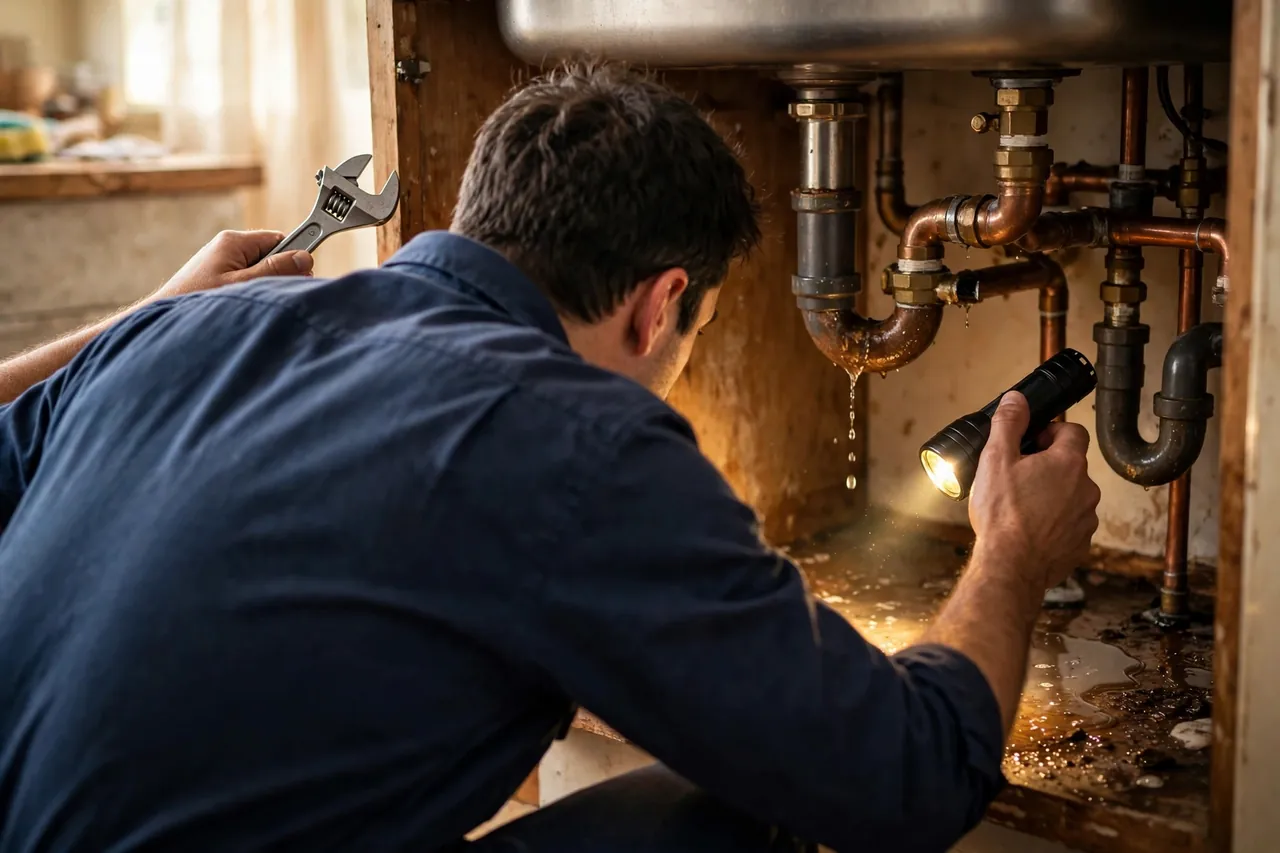
I’m Dan Reeves, a licensed master plumber with 20 years in residential work and more than 4,000 jobs behind me. I am not an insurance agent, and nothing here replaces reading your own policy — but I have stood in hundreds of flooded kitchens while homeowners called their insurers, and I have watched the same misunderstanding play out for two decades. People believe their policy covers “plumbing problems.” It does not. It covers something narrower and stranger, and understanding that distinction before water is on your floor is worth thousands of dollars.
Quick answer: Home insurance usually pays for the damage from a sudden, accidental plumbing failure — soaked floors, walls, and belongings — but not for repairing the pipe that failed, and not for slow leaks, wear and tear, or sewer backups without a special endorsement. The average water damage claim pays out around $14,000, so the distinction matters.
What does a standard policy cover, and what does it deny?
The whole game is two words in your policy: sudden and accidental. A pipe that bursts on Tuesday is an event. A pipe that wept for six months is maintenance. Here is how the common scenarios sort out.
| Scenario | Water damage covered? | Pipe/appliance repair covered? |
|---|---|---|
| Pipe bursts suddenly, floods kitchen | Yes, typically | No — the failed pipe is on you |
| Frozen pipe cracks and thaws | Yes, if the home was heated and occupied normally | No |
| Washing machine hose lets go | Yes | No — a new hose is maintenance |
| Water heater ruptures | Yes, for the flood damage | No — unless you carry equipment breakdown coverage |
| Slow leak under a sink for months | No — gradual damage exclusion | No |
| Corroded pipe finally leaks | Usually no — wear and tear | No |
| Sewer or drain backup into the house | No, without a water backup endorsement | No |
| Flood from rain or rising water outside | No — that is separate flood insurance | No |
One more line item that surprises people, in the good direction: on a covered event, many policies pay the cost of tearing out and putting back whatever blocks access to the leak — drywall, tile, even sections of slab. That access coverage is exactly why the paperwork sequence in the claim section below matters.
Why does the sudden-versus-gradual line decide everything?
Adjusters are trained to date damage. Mold colonies, rot patterns, rust streaks, and swollen cabinet bases all tell a timeline story, and if the story says “this has been wet for months,” the claim dies as a maintenance issue. Insurers reason that a homeowner who fixes small leaks promptly never lets them become big claims, and your policy’s fine print agrees with them — look for exclusions naming “constant or repeated seepage,” “wear and tear,” and “neglect.”
This is also why I tell homeowners that finding a leak early is an insurance strategy, not just a plumbing one. The same failed supply line is a $300 repair when you catch it the week it starts, and an uncovered $8,000 cabinet-and-flooring loss when you catch it in month four. My walkthrough of how to find a water leak in your house is written for exactly that gap.
What about the big-ticket plumbing disasters?
Three scenarios deserve their own words because the dollar figures change the advice.
A burst pipe while you are away. Covered, usually — and the bills are why. Water running at full pressure for a weekend warps hardwood, swells subfloor, and seeds mold through two rooms. Full repairs after an event like that routinely run into five figures, and the average water damage claim overall pays around $14,000 according to industry data. This scenario is what your deductible math should be built around. My emergency playbook in burst pipe: what to do covers the first hour, which is where claims are saved or squandered.
A slab leak. The split coverage here is the most confusing in the business: insurers commonly pay to open and restore the slab to reach a sudden leak, plus resulting damage, while the pipe repair itself stays on you. I break down those numbers in slab leak repair cost.
A sewer backup. Excluded by default, catastrophic in practice. Raw sewage in a finished basement means biohazard cleanup, flooring and drywall out, and contents lost — easily a $10,000-plus event. The fix is a water backup endorsement bought before the event, commonly sold with $5,000 to $10,000 limits. If your home has any drain below the level of the street sewer, buy it.
How do you file a plumbing water damage claim the right way?
The order of operations matters, and I have watched homeowners hurt their own claims by cleaning up too eagerly.
- Stop the water. Main shutoff first, questions later. Insurers expect you to mitigate — damage that grows because water ran for hours hurts your claim and your house.
- Document before you touch anything else. Photos and video of the source, the standing water, and every damaged item. Get the failed part photographed in place.
- Keep the failed part. Do not let anyone throw away the burst hose or split pipe. It is evidence, and adjusters ask for it.
- Call the insurer promptly and get a claim number before authorizing demolition. For access-covered work like opening a slab or wall, prior approval protects you.
- Dry aggressively. Fans, dehumidifiers, or a mitigation company. Mold clocks start at 24 to 48 hours, and mold from a covered event is often covered only up to a limit.
- Get the plumber’s invoice separated. Pipe repair (your cost) itemized apart from access and restoration work (potentially the insurer’s). Clean paperwork is what turns policy language into an actual check.
How do you keep a claim from being denied before it happens?
The cheapest claim strategy is not needing luck when the adjuster arrives. Three habits separate the homeowners whose claims sail through from the ones who fight for months.
Keep basic maintenance evidence. You do not need a filing cabinet, but a phone photo of a replaced supply hose with the date on it, an invoice from the last water heater swap, or a plumber’s receipt for fixing a drip proves the pattern insurers want to see: this home was maintained, and this failure was sudden anyway. When the failed part is a 15-year-old hose with no history, the adjuster writes “wear and tear” before he writes anything else.
Install leak detection where it counts. Battery water alarms cost little and sit under sinks, behind washers, and beside water heaters, sounding off at the first puddle. Automatic shutoff systems go further, watching flow and closing the main when the pattern screams leak. Some insurers offer premium discounts for them, but the real value is converting a four-day vacation flood into a four-minute puddle — and a claim nobody can call gradual.
Know your shutoff and your numbers cold. Every adult in the house should be able to close the main water valve in the dark. Add your deductible, your water backup limit, and your insurer’s claim line to the same note on the fridge. In a flooding kitchen, the family that acts in minute two loses hundreds; the family that finds the valve in hour two loses thousands — and hands the adjuster a mitigation argument for free.
Which endorsements are actually worth buying?
Two add-ons close the biggest plumbing gaps in a standard policy. Water backup / sump overflow coverage handles the sewer scenario above — for most homeowners it costs modestly per year relative to a single $10,000 backup, and it is the endorsement I recommend without hesitation. Service line coverage pays for the underground water and sewer lines between the street and your house, which are entirely your responsibility and entirely excluded from a standard policy; a failed underground line is a several-thousand-dollar excavation job. Equipment breakdown is the third, covering appliances like the water heater itself when they fail mechanically or electrically. While you are reading the policy, check two quieter numbers as well: many policies cap mold remediation at a sublimit well below your main coverage, and some impose a separate, higher deductible specifically for water damage. Neither shows up in the sales brochure. Both show up in the check you eventually receive, and knowing them in advance changes how fast you dry a house out.
When should you call a pro — and which pro first?
For the plumbing, call a licensed plumber as soon as water is loose; the repair itself will almost certainly be your expense, and speed is damage control. For the money, read your declarations page before you need it — today, while everything is dry — and confirm your deductible, your water backup status, and your mold limits. The homeowners who come out whole from a plumbing disaster are never the ones with the best luck. They are the ones who knew, before the pipe burst, exactly which parts of the bill belonged to whom.
Frequently asked questions
Does homeowners insurance cover a burst pipe?
The water damage from a burst pipe, yes — in most standard policies, if the burst was sudden and accidental. Warped floors, soaked drywall, ruined furniture, and a hotel stay while the house is dried out are all typically covered. The pipe itself is the exception: replacing the failed section of pipe is usually considered your maintenance cost, not the insurer's. One caution from the field: if the pipe burst because it froze in a house where the heat was deliberately left off, insurers can and do deny the claim as negligence.
Will insurance cover a slow leak under my sink?
Almost never, and this is the denial I hear about most. A supply line that dripped for three months behind a cabinet is, to an adjuster, a maintenance failure — the damage happened gradually, not suddenly. The same goes for leaks around old caulk, a toilet wax ring that seeped for a year, or any damage your policy's language ties to wear and tear or long-term seepage. The lesson is brutal but simple: the week you find a slow leak is the cheapest week to fix it, because no policy will share that bill with you.
Does home insurance cover sewer backups?
Not on a standard policy. Sewage backing up through drains is excluded unless you bought a water backup or sump overflow endorsement, which adds that protection back, commonly with limits in the $5,000 to $10,000 range per event. Given that a single backup can destroy a finished basement, I consider that endorsement the best money in the whole policy for anyone with drains below street level. If you are not sure whether you have it, check your declarations page today — after a backup is the worst time to read your policy for the first time.
Should I file a claim for plumbing water damage or pay out of pocket?
Run the math against your deductible first. Policies typically carry deductibles from $500 to $2,500, and a claim also goes on your record — multiple water claims in a few years can raise premiums or get a policy non-renewed. My rule of thumb: if the total damage is within about twice your deductible, paying out of pocket is often cleaner. If you are looking at flooring, drywall, and mold remediation in the thousands, file promptly and document everything. Either way, stop the water and dry the structure fast; insurers can reduce payment if you let damage grow after the event.
Does insurance pay for the plumber to fix the leak itself?
Generally no. The standard principle is that the policy covers damage caused by the plumbing failure, not the failure itself — the pipe, hose, valve, or appliance that let go is yours to repair or replace. There are narrow exceptions: many policies will pay the cost of tearing out and replacing walls, slab, or flooring purely to access a covered leak, even though the pipe repair inside that opening is on you. Equipment breakdown endorsements can also cover a failed appliance like a water heater. But budget for the plumber's repair bill as your own money, and be pleasantly surprised if any of it is reimbursed.