Repair or Replace a Water Heater? The 50% Rule Decides
Every week a homeowner asks me the same question over a silent water heater: is this worth fixing, or am I throwing money at a dying tank? I am Dan Reeves, a licensed master plumber with 20 years and more than 4,000 jobs behind me. The industry has a tool for this decision, and it is not a symptom list or a gut feeling. It is a single arithmetic rule, and once you know it, most repair-or-replace calls make themselves.
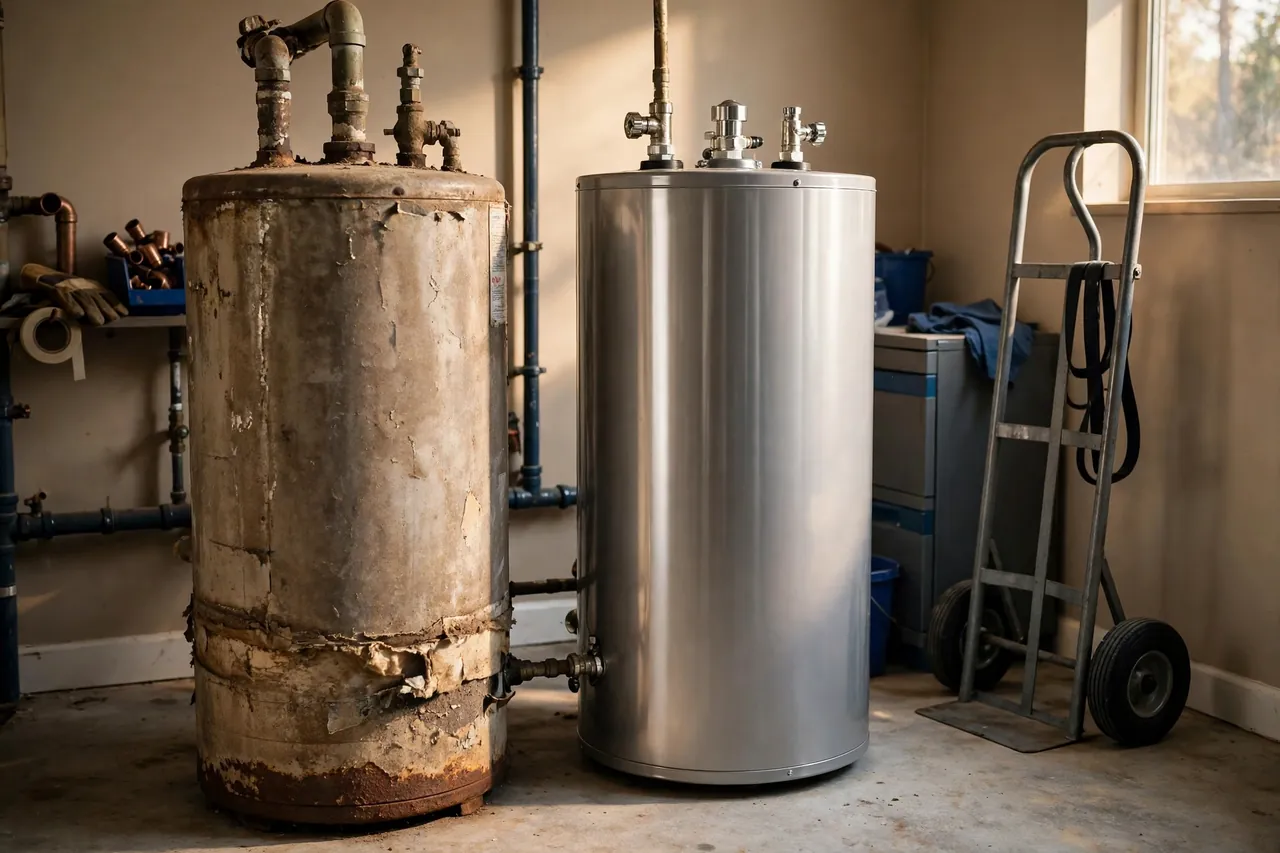
Every week a homeowner asks me the same question over a silent water heater: is this worth fixing, or am I throwing money at a dying tank? I am Dan Reeves, a licensed master plumber with 20 years and more than 4,000 jobs behind me. The industry has a tool for this decision, and it is not a symptom list or a gut feeling. It is a single arithmetic rule, and once you know it, most repair-or-replace calls make themselves.
Quick answer: Use the 50% rule — if the repair quote exceeds half the cost of a new heater installed, replace it. On a standard tank installing for $1,300 to $2,400, that means repair quotes past roughly $650 to $1,200 end the debate. Two overrides: a leaking tank is always a replacement regardless of cost, and a repair on a heater already past its 10 to 12 year expected life rarely pays even when it is cheap.
What is the 50% rule, and how do you run your numbers?
The rule is exactly what it sounds like: when a single repair costs more than 50 percent of a full replacement, the replacement is the better buy. Rheem states it plainly in its own guidance — if the repair’s cost exceeds roughly 50 percent of the price of a new unit installed, replacement is almost always the better investment. Plumbers have used the same threshold for decades because the logic is hard to argue with: past halfway, you are spending new-heater money to keep an old heater.
Here is the rule working on real numbers:
| Your situation | Repair quote | New heater installed | Repair as % of replacement | The call |
|---|---|---|---|---|
| 5-year-old tank, dead heating element | $250 | $1,800 | ~14% | Repair, no debate |
| 7-year-old tank, failed gas valve | $450 | $1,800 | ~25% | Repair |
| 9-year-old tank, burner assembly failing | $950 | $1,800 | ~53% | Replace |
| 11-year-old tank, second repair this year | $600 (plus $350 last spring) | $1,800 | ~53% cumulative | Replace |
| Any age, tank itself leaking | Any number | $1,800 | — | Replace, always |
Two details matter in that table. First, the percentage is calculated against the installed replacement cost, not the shelf price of the unit — installation, permit, and code items are real money you would actually spend. Second, cumulative repairs count. A $300 fix in March and a $400 fix in October on the same aging tank is a $700 pattern, and the rule should be applied to the pattern, not to each invoice in isolation. The trap I watch homeowners fall into is evaluating every repair as if it were the first.
How much do common water heater repairs actually cost?
You cannot apply the rule without honest repair prices, so here are the ones I quote constantly:
| Repair | Typical installed cost | What it usually means |
|---|---|---|
| Heating element or thermostat (electric) | $150–$400 | Isolated part failure; repair at almost any age under 12 |
| Thermocouple or pilot assembly (gas) | $100–$200 | Minor; repair even on older units |
| Temperature and pressure (T&P) valve | $100–$250 | Repair — but ask why it is discharging first |
| Anode rod replacement | $150–$300 | Maintenance, not failure; extends tank life |
| Gas control valve | $300–$600 | The gray zone — age decides |
| Burner assembly or major gas work | $600–$1,000+ | Usually past the 50% line on older tanks |
| Full tank replacement, installed | $1,300–$2,400 | Resets the clock with a fresh warranty |
If the pilot will not stay lit, that is usually the $100 to $200 row, not a replacement — I walk through the diagnosis in pilot light keeps going out. If the tank rumbles and pops, you may be looking at a flush rather than a repair bill at all, which is covered in water heater popping noise. Read the symptom before you price the fix, because several expensive-sounding problems are cheap parts wearing out exactly as designed.
Which water heater problems can never be repaired?
One, and it outranks every calculation in this guide: a tank that leaks from the tank itself. The steel vessel has corroded through from the inside. There is no patch that restores a pressure vessel, no coating that buys meaningful time, and no honest plumber who will offer one. Water pooling at the base with no fitting or valve above it wet means replacement, full stop.
The near-unrepairable second case is rusty hot water on an old tank. If the hot water runs brown and the anode rod pulls out as bare wire on a 10-year-old heater, the tank has been corroding unprotected for years and the damage is done — a new rod at that point is decoration. I cover that inspection in detail in water heater anode rod replacement. Everything else on a water heater — elements, thermostats, valves, thermocouples, even the gas control — is a replaceable part, and the decision is purely the math of the rule and the age of the tank.
How does age change the repair-or-replace math?
Age is the rule’s silent partner. A standard gas tank typically lasts 8 to 12 years, an electric tank 10 to 12, and tankless units 15 to 20 or more — my full breakdown by type and fuel is in how long do water heaters last. Apply the rule inside that lifespan and the pattern looks like this:
| Symptom | Tank under 8 years | Tank 8–12 years | Tank over 12 years |
|---|---|---|---|
| Rumbling, popping, sediment noise | Flush it — likely fine | Flush and evaluate honestly | Lean replace |
| Rusty hot water only | Anode rod — $150–$300 repair | Check rod; lean replace if rod is gone | Replace |
| Runs out of hot water fast | Element or thermostat — repair | Repair if the part is cheap | Replace |
| Pilot keeps going out | Thermocouple — repair | Thermocouple — repair | Repair the part, plan the replacement |
| Water pooling at the base | Replace (tank failure) | Replace | Replace |
| Second breakdown this year | Repair, watch it | Replace | Replace |
The logic under the table: on a young tank, a failed part is usually just a failed part, and the remaining years of tank life make the repair valuable. On an old tank, the same failed part is a messenger — the other components are the same age, in the same water, and statistically next. That is why a $150 element swap that is obviously right at year five is genuinely questionable at year eleven even though it passes the 50% test easily. The rule gives you the ceiling. Age tells you how much of the remaining life you are actually buying.
Before you price anything, find your tank’s real age. It is encoded in the serial number on the rating plate — most manufacturers bury the month and year in the first few characters. Deciding repair versus replace without that date is guessing with a wrench.
When does repairing anyway beat the rule?
Three situations, and I recommend all three without hesitation.
The heater is young and under warranty. A $600 repair on a 3-year-old tank may exceed 50 percent of nothing that matters — the parts may be covered outright, and you are protecting nine or more remaining years of service life. Run the warranty before you run the rule.
The failure is a cheap wear part on a sound tank. Thermocouples, elements, and T&P valves are designed to be replaced. If the tank is dry, the water is clear, and the quote is in the $100 to $400 band, repair it and move on, at almost any age.
You are selling the house within the year. A working, honestly repaired heater with a documented invoice satisfies most buyers and inspectors. Spending $2,000 to hand a stranger a new tank rarely returns $2,000 at closing. Disclose the age, keep the paperwork, and let the math serve your situation instead of a rule of thumb.
The common thread: the 50% rule assumes you keep the house and the heater. Change either assumption and the right answer can change with it — but it should change deliberately, not because someone waved a symptom list at you.
What should you do before you decide either way?
Three cheap steps that sharpen every decision. First, flush the tank if it has not been done in a year — sediment causes noise, slow recovery, and apparent capacity loss that mimic dying heaters, and the flush costs you an hour. The steps are in how to flush a water heater. Second, check the anode rod on any tank over 4 years old; its condition is the single best X-ray of what is happening inside the steel. Third, get the replacement quote at the same time as the repair quote. The 50% rule is unusable with only one number, and any plumber who will quote a repair but not the replacement is deciding for you.
If replacement does win, that is also the moment to ask whether the same tank is still the right appliance — households change, and the tankless comparison in tankless vs tank water heater is worth ten minutes before you reinstall the same capacity you bought a decade ago.
When should you call a pro for the repair-or-replace call?
Call when the quote lands anywhere near the 50% line, when you have had two breakdowns inside a year, when the water at the base could be tank or fitting and you cannot tell, or when the tank is past 10 years old and anything beyond a minor part has failed. Ask the plumber for both numbers in writing — repair and replacement, side by side — and ask for the serial-number date if you could not decode it. A pro who runs the rule with you, using your tank’s actual age and actual quotes, is giving you the same framework I have used on thousands of jobs. One who will only quote the repair is hoping you never learn it exists.
Frequently asked questions
What is the 50% rule for water heaters?
If a repair costs more than 50 percent of what a new water heater costs installed, replace the heater instead of repairing it. On a typical standard tank that installs for $1,300 to $2,400, the line sits around $650 to $1,200 in repair quotes. Rheem, one of the largest water heater manufacturers, publishes the same guidance. The rule works because past that threshold you are buying half a new heater with none of the benefits — no fresh warranty, no efficiency gain, and a tank that is still old everywhere the repair did not touch.
At what age should you stop repairing a water heater?
For a standard tank, I stop recommending meaningful repairs at 10 to 12 years, because that is the expected service life — gas tanks typically run 8 to 12 years and electric tanks 10 to 12. Past that mark, even a cheap repair is usually the first of several, since one failing component on an old unit is rarely the only one close to failing. Cheap, isolated fixes like a thermocouple are still fine on an older unit. Anything involving the tank, the burner assembly, or a quote past a few hundred dollars should trigger the replacement conversation instead.
Can a leaking water heater tank be repaired?
No. A leak that comes from the tank itself — as opposed to a fitting, valve, or supply line above it — means the steel has corroded through, and there is no patch, coating, or repair that restores a pressure vessel. That heater gets replaced, every time. The good news is that many leaks blamed on tanks actually come from the temperature and pressure valve, a threaded fitting, or the drain valve, all of which are repairable. Shut the water off, dry everything, and find the highest wet point before you accept a replacement quote.
Is it worth repairing a water heater twice in one year?
Almost never on a heater over 8 years old. Two repairs in 12 months is not bad luck — it is a pattern of system-wide wear, and the second invoice usually means a third is coming. Add the two bills together and you have often spent 40 to 60 percent of a replacement without buying any of a new unit's life or warranty. On a younger heater, two unrelated part failures can be coincidence and worth fixing. The age of the tank is what separates coincidence from pattern, which is why I want the manufacture date before I answer this question on any job.
How much does a new water heater cost installed in 2026?
A standard 40 or 50 gallon tank, professionally installed, typically runs $1,300 to $2,400 in most markets, with the unit itself, labor, permit, and basic code requirements included. Straightforward swaps in an accessible utility space land at the low end. Older homes can add $400 to $800 when venting, expansion tanks, drain pans, or seismic strapping need to be brought up to current code. Tankless replacement is a different class of job at roughly $3,500 to $7,500. Get the code-upgrade items listed separately on the quote so you can see what you are actually paying for.