PEX vs Copper for Repiping: Costs, Lifespan & Verdict
It is the one decision every repipe customer has to make before I can write a real quote: PEX or copper? I am Dan Reeves, a licensed master plumber, and I have repiped more than 600 houses in 20 years — most of them in PEX, a meaningful minority in copper, and a few in both. The material debate generates strong opinions and weak information. This guide replaces both with numbers: what each material costs per foot and per house, how long each actually lasts, how each behaves in a freeze and in bad water, and the specific situations where I still spec copper in 2026.
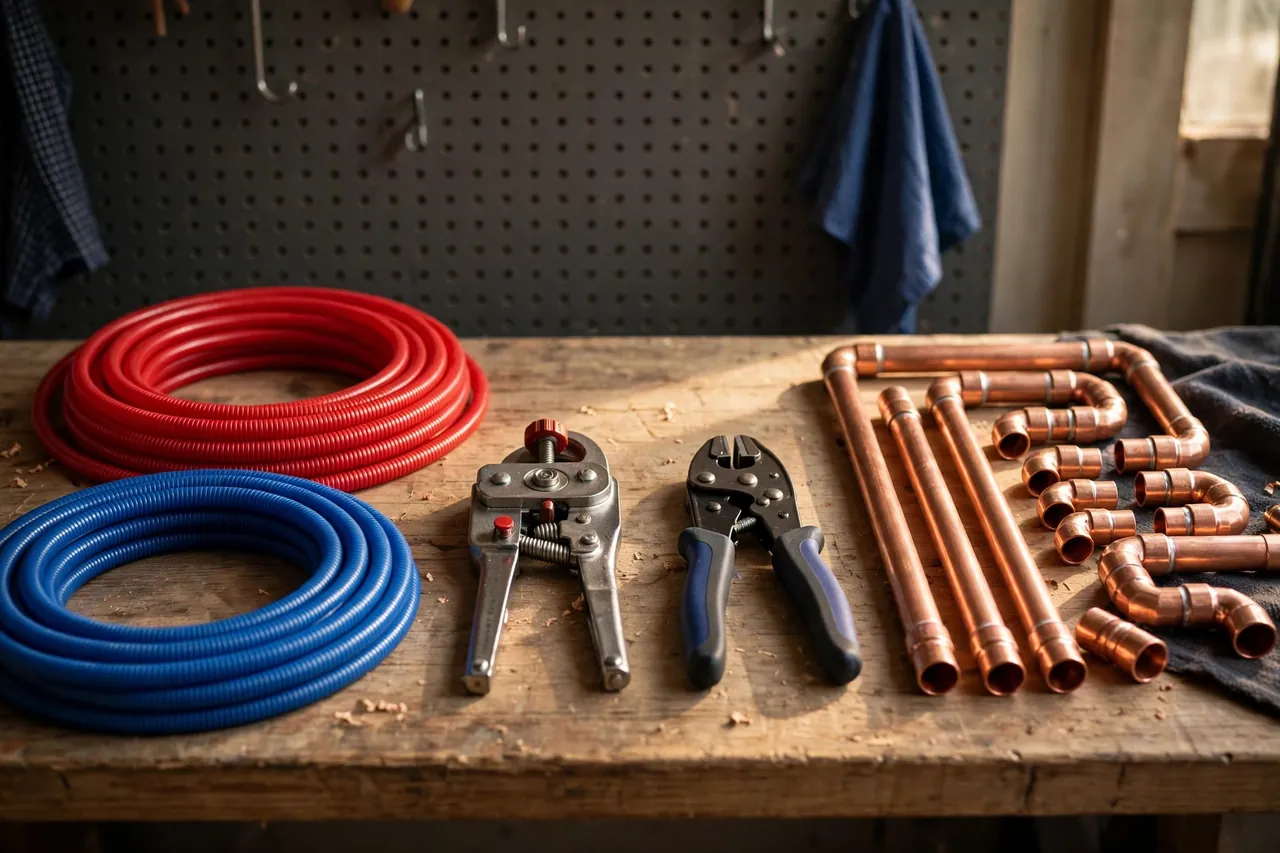
It is the one decision every repipe customer has to make before I can write a real quote: PEX or copper? I am Dan Reeves, a licensed master plumber, and I have repiped more than 600 houses in 20 years — most of them in PEX, a meaningful minority in copper, and a few in both. The material debate generates strong opinions and weak information. This guide replaces both with numbers: what each material costs per foot and per house, how long each actually lasts, how each behaves in a freeze and in bad water, and the specific situations where I still spec copper in 2026.
Quick answer: For a typical whole-house repipe, choose PEX — a two-bathroom house runs $6,000 to $10,000 in PEX against $9,000 to $15,000 in copper, and PEX handles freezes and aggressive water better. Choose copper for exposed runs, rodent-prone walls, and where code or a genuinely long ownership horizon justifies the premium. Not sure your house needs a repipe at all? Run your own numbers first with the repiping cost calculator, then come back for the material decision.
How do PEX and copper compare side by side?
| Factor | PEX | Copper |
|---|---|---|
| Material cost per linear foot | $0.50–$2 | $2–$8 |
| Installed cost per square foot of home | $3.50–$7 | $8–$14 |
| Rated lifespan | 25–50 years | 50–70 years |
| Freeze behavior | Expands slightly; often survives | Rigid; splits and bursts |
| Corrosion behavior | Immune to pitting and scale | Can pit in acidic or aggressive water |
| Fittings in a typical run | Few — bends around framing | One at nearly every turn, soldered |
| Noise | Quiet; dampens water hammer | Can bang and tick with pressure changes |
| UV resistance | Poor — indoor use only | Excellent |
| Rodent resistance | Vulnerable to chewing | Not chewable |
| Heat tolerance | Rated to about 180–200°F | Rated far higher; standard near boilers |
| Recyclable | No | Yes, with real scrap value |
The material figures are Angi’s published per-foot prices; the installed per-square-foot ranges are the ones I quote from on real jobs, and they include labor, fittings, valves, and permit. Read the table the way an estimator does: copper’s advantage column is durability and environment resistance, PEX’s column is money, speed, and water chemistry. Neither column is imaginary. The question is which one matches your house.
What does a whole-house repipe cost in each material?
Material choice moves a repipe quote more than any other single variable — typically 40 to 60 percent between the two. Here are the full-service installed totals I see in 2026, pipe, fittings, labor, permit, and pressure testing included (drywall patching extra):
| Repipe scope | PEX installed | Copper installed |
|---|---|---|
| 1-bathroom house or condo | $4,000–$6,500 | $6,000–$10,000 |
| 2-bathroom house | $6,000–$10,000 | $9,000–$15,000 |
| 3-bathroom house | $9,000–$15,000+ | $13,000–$22,000+ |
| Average whole-house job | ~$7,500 | ~$11,000–$12,000 |
National guides bracket the same work widely — HomeGuide puts whole-home repipes anywhere from $2,000 to $15,000 depending on scope, and Angi puts the typical job right around $7,500, which matches my PEX average almost exactly. The low ends of the national ranges generally assume small homes, easy crawl-space access, and minimal fixture counts; the table above is the full-service version of the job. My complete pricing breakdown, including permits, patching, and how access changes the bid, is in cost to repipe a house. If you want your house’s number rather than a national range, the repiping cost calculator will build it from your bathroom count and access type in about a minute.
Why is the gap so large? Roughly half is the material itself — $0.50 to $2 a foot against $2 to $8 a foot adds up over 300 to 400 feet of pipe. The other half is labor. A PEX run from a manifold to a bathroom can be one continuous bend with zero fittings inside the wall. The same run in copper is a dozen cut lengths and soldered joints. My crews finish a typical PEX repipe in two to three days; the same house in copper takes three to five, and labor is 60 to 70 percent of any repipe bill.
Which lasts longer, PEX or copper?
Copper, on ratings and on track record. Angi credits copper with 50 to 70 years against 25 to 50 for PEX, and copper systems installed in the 1960s are still in service all over the country — no PEX system is old enough to have proven a 60-year life yet, though nothing in its field performance so far suggests it will not get there.
Two honest qualifications. First, copper’s rating assumes friendly water. In acidic water — low pH well water is the classic case — copper corrodes from the inside, develops pinhole leaks, and can fail in 15 to 25 years. If your house is being repiped because the water ate the last set of copper pipes, installing the same material again is ignoring the diagnosis. PEX is chemically inert to that water. Second, PEX’s rating is dragged down by its fittings and its enemies rather than the tubing itself: UV exposure before installation, chronic rodent access, and sustained high-temperature recirculation are what kill PEX systems early. Installed indoors, protected, and within its temperature rating, PEX tubing should serve 40 years or more.
How do they handle freezing, hard water, and noise?
Freezing is PEX’s clearest win. When water freezes inside PEX, the tubing expands slightly and usually returns to shape when it thaws. Copper has no give; frozen water splits it, and the leak announces itself at thaw. For vacation homes, exterior-wall runs, and anywhere north of the Mason-Dixon line, this is a genuine functional advantage, not a marketing point.
Hard water and scale favor PEX as well. Its smooth interior gives mineral scale little to grip, and flow stays consistent. Copper handles scale reasonably but loses to aggressive chemistry as described above.
Noise favors PEX quietly, literally. Flexible tubing absorbs the pressure shock that makes rigid copper bang — the 2 a.m. water hammer when a valve snaps shut is mostly a copper-system sound. In a quiet house with bedrooms over the mechanical room, homeowners notice this difference every single night.
Where does copper still win?
I spec copper, without apology, in five situations: exposed mechanical rooms, where its rigidity looks professional and it tolerates heat near boilers and water heaters that would exceed PEX’s temperature rating; runs exposed to sunlight, including some garage and exterior applications, because UV degrades PEX; houses with real rodent pressure in the walls or attic; jurisdictions whose code still restricts plastic supply pipe in certain occupancies; and short partial repipes tying into an existing copper system, where matching the material is cleaner than transitioning for a six-foot run. Copper is also fully recyclable with genuine scrap value, which matters to some homeowners and slightly offsets material cost when old lines are salvaged.
Where does PEX win outright?
Budget, obviously — but also freeze-prone houses, aggressive water, speed (a PEX repipe gets your water back sooner, with fewer days of disruption), and reliability in the walls: every soldered fitting hidden in a wall is a future leak candidate installed by the dozen, while a bent PEX run has none. That last point is the one I make most often at kitchen tables, because homeowners count fittings as a cost issue when it is really a leak-probability issue. Fewer joints, fewer joints to fail.
If you are still at the stage of wondering whether your house needs this surgery at all, read the signs your house needs repiping before you spend a dollar on material decisions — a house with sound copper and one bad branch needs a repair, not a repipe in either material.
Can you mix PEX and copper in one house?
Yes, and on many of my jobs the hybrid is the smartest specification: PEX for the long interior distribution runs where its flexibility and price shine, copper for the exposed mechanical-room work, the water heater connections, and any run exposed to heat, sunlight, or rodents. Transition fittings between the two are standard, code-accepted, and reliable. What I do not mix is randomly — the transition points should be planned, accessible, and documented, so the next plumber who opens a wall understands the system instead of discovering it.
When should you call a pro about the PEX versus copper decision?
Call for a repipe assessment when you have had two leaks in a year, when your water runs rusty after sitting, or when you know your pipe is galvanized or polybutylene — and before you hire anyone for a job this size, read plumber vs handyman, because a repipe is permitted, inspected work in every state I know of. Bring one piece of information to the material conversation that settles half of it: a basic water test. If your water is balanced, copper’s lifespan advantage is real and you are simply deciding whether it is worth 40 to 60 percent more. If your water is aggressive, the debate is over — your house is a PEX house whether you prefer copper or not, and a good plumber will tell you so even though the copper quote would have paid him more.
Frequently asked questions
Is PEX or copper better for a whole-house repipe?
For most houses, PEX is the better value. It installs for roughly $3.50 to $7 per square foot against $8 to $14 for copper, bends around framing with far fewer hidden fittings, and shrugs off freeze events that split rigid pipe. Copper earns its premium in exposed mechanical rooms, in homes with rodent pressure in the walls, and where local code restricts plastic pipe. Both materials, installed correctly, give you decades of service. On the typical whole-house job I recommend PEX without hesitation, and copper for specific runs and specific houses — not as a default.
How much cheaper is a PEX repipe than a copper repipe?
On a typical two-bathroom house, PEX runs $6,000 to $10,000 installed while copper runs $9,000 to $15,000 — a difference of roughly 40 to 60 percent. The gap comes from both ends: the material itself costs $0.50 to $2 per foot against $2 to $8 per foot (Angi's figures), and PEX installs in about two-thirds the labor time because it bends instead of needing a soldered fitting at every turn. On a three-bathroom house the absolute difference can exceed $6,000, which buys a lot of drywall patching and then some.
Does copper really last longer than PEX?
On rated lifespan, yes. Angi puts PEX at 25 to 50 years and copper at 50 to 70 years, and copper's track record in the field is longer because it has been in houses since the 1960s. The honest caveat is water chemistry. Copper's lifespan assumes reasonably balanced water — aggressive, acidic water can pit copper from the inside and kill a system in 15 to 25 years, while PEX is essentially immune to that failure mode. Ask which lifespan applies to your water, not which number is bigger in a brochure. A water test settles it.
Will repiping with PEX hurt my home's resale value?
Not in any market I work in. Inspectors and buyers care that old galvanized or polybutylene pipe is gone, that the work was permitted, and that the documentation exists. A permitted PEX repipe with paperwork removes the objection just as completely as copper does. Appraisers do not assign a line-item value to pipe material. Where copper still carries a perception premium is in high-end listings with exposed mechanical work, where the piping is visible and neatness reads as quality. Inside closed walls, nobody has ever paid more for a house because of what the water runs through.
Can rodents really chew through PEX?
Yes, it happens — rats and mice will occasionally gnaw PEX tubing, particularly in attics and crawl spaces where they already travel, and a single chew-through can flood a ceiling. It is not common, and it is manageable: runs can be routed away from known rodent paths, protected with metal shielding in vulnerable stretches, and combined with actual pest control. But I take the risk seriously in houses with an active or recurring rodent problem, and in those homes I will often spec copper for the exposed attic and crawl runs and PEX inside the walls. Pretending the risk is zero would be dishonest.