Hydro Jetting vs Snaking: Which One Does Your Clog Need?
Homeowners ask me to settle the hydro jetting vs snaking argument almost every week, usually after paying for the same clog twice. I am Dan Reeves, a licensed master plumber with 20 years and more than 4,000 jobs behind me, and here is the honest version: these are not two ways of doing the same job. A snake opens a drain. A jetter cleans a pipe. Picking between them is not about which one is "better" — it is about what is actually inside your line.
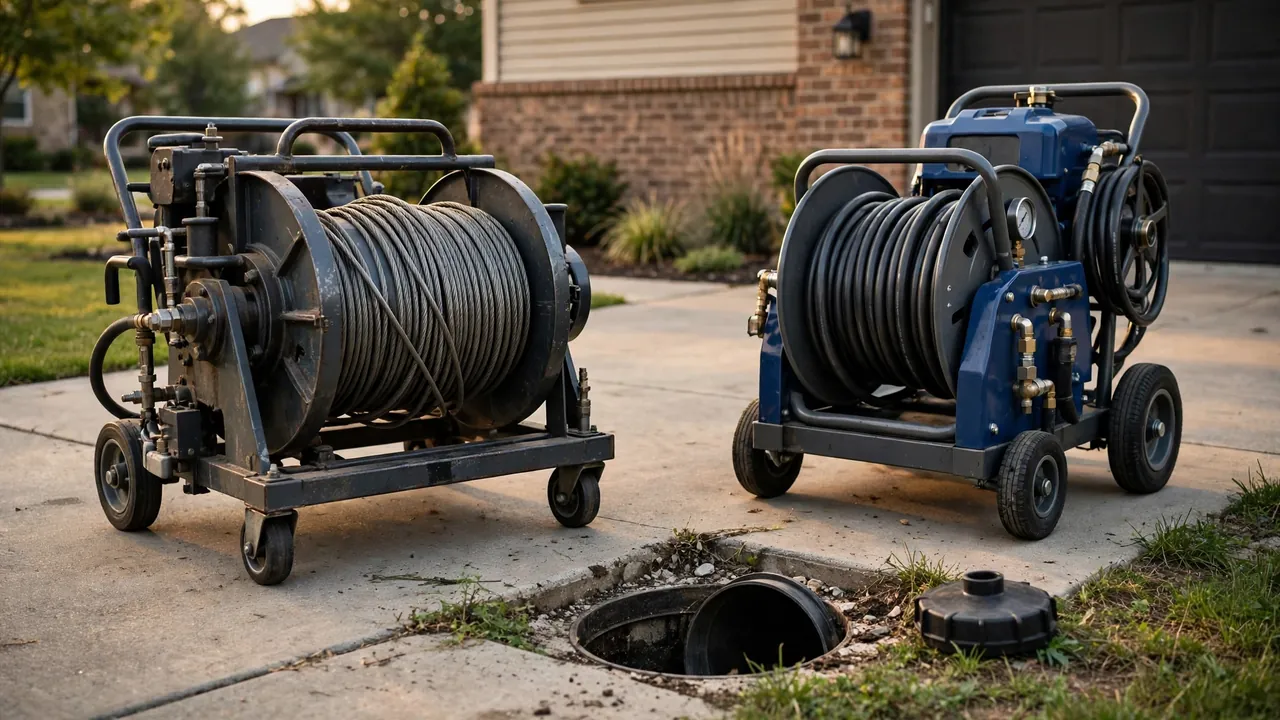
Homeowners ask me to settle the hydro jetting vs snaking argument almost every week, usually after paying for the same clog twice. I am Dan Reeves, a licensed master plumber with 20 years and more than 4,000 jobs behind me, and here is the honest version: these are not two ways of doing the same job. A snake opens a drain. A jetter cleans a pipe. Picking between them is not about which one is “better” — it is about what is actually inside your line.
Quick answer: Snake a first-time, single-fixture clog with an obvious cause — snaking runs $95 to $300 and that is all the problem needs. Jet a line that clogs repeatedly, carries grease, or has roots or scale on the walls — hydro jetting runs $350 to $1,200 and typically lasts 2 to 4 years instead of months. On any line over 40 years old, camera it before anyone jets it.
How do snaking and hydro jetting actually differ?
Everything in this comparison flows from one mechanical fact: what each tool does to the pipe wall.
| Factor | Snaking (cable machine) | Hydro jetting |
|---|---|---|
| How it works | Rotating steel cable with a cutting or retrieving head | Water at 3,000–4,000 PSI through forward and rear-facing nozzles |
| What it does to the clog | Punches a channel through it | Strips it off the wall and flushes it out |
| Pipe wall afterward | Still coated with grease, soap, or scale | Bare pipe, near full original diameter |
| Best for | Single clogs, solid objects, hair, first-time blockages | Recurring clogs, grease, scale, root masses |
| Typical residential price | $95–$300 | $350–$1,200 |
| Typical time before it clogs again | 3–12 months on buildup-prone lines | 2–4 years on the same lines |
| Pipe risk | Low on almost any pipe | Needs a camera check first on old clay, cast iron, or Orangeburg |
| DIY realistic? | Hand augers only, for simple traps | No — pro rigs are a different class of machine |
A cable machine is a retriever and a drill. It is excellent at grabbing a hair mass, shredding a wad of wipes, or boring through a soft blockage so water can pass. What it cannot do is clean. The cable rides down the center of the pipe and never scrapes the wall around it.
A jetter is a pressure washer engineered for the inside of a pipe. The nozzle fires jets forward to cut into the blockage and jets backward to pull the hose deeper while scouring the wall behind it. Grease, scale, and fine root hairs that a cable slides past get stripped and flushed to the main. That wall contact is the entire difference, and it is why the two services have different prices and different lifespans. For the full pricing breakdown of the jetting side, see my guide to hydro jetting cost.
What does each method cost, and what does the cheap one really cost?
Per visit, snaking wins and it is not close. A standard residential snaking runs $95 to $300. Hydro jetting runs $350 to $1,200, with a typical main line job landing between $450 and $750. HomeTips’ published comparison brackets the same services at $100 to $300 for snaking and $350 to $600-plus for jetting, and local companies across the country quote inside those same bands. The jetter costs more because the rig costs more — a truck-mounted pump, tank, and 400 feet of hose is serious capital next to a motor and a cable — and because a thorough jetting job with slow, repeated passes takes longer.
Where homeowners get burned is comparing the invoice instead of the year. Take a kitchen main that fouls with grease. Snake it for $240. It slows again in eight months. Snake it again. Three visits in two years is $720 and counting, and the line is still coated. Jet it once for $685 with a camera pass and the same household typically goes 2 to 4 years. I have watched this exact math play out on my own route more times than I can count. The cheap service, repeated, is the expensive service.
The reverse is also true, and jetting companies will not tell you this part. If the clog is a one-time event — a flushed toy, a single hair clog in a tub — there is no wall buildup to remove, and the $600 jetting job buys you nothing the $150 snake job did not. Cost per visit is the right comparison for one-time clogs. Cost per year is the right comparison for recurring ones.
Which clogs does snaking handle better?
Snaking is the right tool, full stop, in four situations I run into constantly.
A first-time clog with a known cause. Something went down that should not have, the drain blocked, end of story. There is no coating problem to solve.
Small branch lines. A 1.5-inch bathroom drain with a hair clog does not need a jetter, and the thin fittings on older branch lines were never built for one. A cable or a hand auger is the proportionate tool.
Retrieving an object. A cable with a retrieving head can grab a lost item or a lodged toy. A jetter just pushes it deeper. If something valuable or obstructive is in the line, you want the grabber, not the fire hose.
A pipe you do not trust yet. On a fragile line that has not been camera-inspected, a cable at low speed is the gentler way to restore flow today while you plan the real fix. Jetting a pipe you suspect is rotten is gambling.
I snake drains every working day. It is not the lesser service. It is the correct service for the majority of clogs — the stubborn minority are what jetting exists for.
When does hydro jetting win outright?
Three job profiles send me straight to the jetter.
The recurring grease line. Restaurants foul lines fastest, but a home kitchen that cooks daily builds the same layered grease coating, just slower. If you have paid to clear the same line twice in two years, the wall is the problem, and only jetting addresses the wall. Snaking that line a third time is buying the same temporary hole again.
Roots at multiple joints. A cable cuts the roots it reaches at one joint. A jetter with a root-cutting nozzle works the full length of the line in one visit, shredding root masses and flushing the debris out instead of leaving it matted at the joints. If the camera shows roots at four joints, one cable pass is a trim, not a treatment.
Scale in older cast iron. Hard water and corrosion narrow cast iron from the inside, and the rough scale catches everything that flows past. A cable cannot restore diameter. Jetting knocks the scale down and gives you back the pipe you actually own. For what standard cleanings cost across the board, my drain cleaning cost guide lays out the full menu.
One boundary matters here: if several fixtures back up together, or sewage comes up in a tub or floor drain, you may not have a cleaning problem at all. Work through the signs of a main sewer line clog first, because a collapsed or bellied line needs repair, and no pressure nozzle fixes a pipe that has lost its slope.
Can either method damage your pipes?
Jetting gets the questions, so let me be direct. On sound pipe — modern PVC, ABS, or cast iron in good condition — hydro jetting at professional pressures is safe and I run it without hesitation. The danger is real but specific: high-pressure water finds weak spots. A cracked clay tile joint, an Orangeburg line that has softened out of round, or a cast iron bottom channel rotted paper-thin can be opened up or blown out by a jet that would polish a healthy line.
That is why the sequence on any suspect line is camera first, jet second. A camera inspection, typically $150 to $500, shows the material, the joint condition, and whether the bottom of the pipe still exists. Companies that will jet a 60-year-old line sight unseen are not being efficient. They are skipping the step that protects you because they do not own the camera.
Snaking is gentler but not harmless. An oversized cutting head forced through a fragile line can crack a weakened joint, and years of repeated aggressive cabling will wear a thin pipe wall thinner. The risk difference is one of degree, not kind — both tools punish bad pipe, jetting just does it faster, which is exactly why diagnosis comes first in my shop.
How long do the results actually last?
On a buildup-prone line, a snaking typically buys 3 to 12 months before the drain slows again, because the sticky wall layer that caught the first clog is still there catching the next one. A properly jetted line starts from bare pipe, and the same household typically gets 2 to 4 years before buildup matters again. HomeTips’ comparison puts jetting at 1 to 3 years against months for snaking — same direction, slightly more conservative numbers.
Roots break every promise either way. If a mature tree sits over your line, roots return regardless of method, and jetting stretches the interval instead of ending it. On heavy root lines I put customers on planned maintenance jetting every 18 to 24 months, which beats emergency calls on price and keeps the line documented on camera year over year.
Your habits set the ceiling. A freshly jetted kitchen line will re-foul in half the time if grease keeps going down the drain in quantity. Wipe pans into the trash, run hot water after using the disposal, and the 2 to 4 year window is realistic.
Can a plumber use both methods on the same job?
Yes, and on ugly lines it is often the smart sequence. A quick cable pass opens a fully blocked line enough to drain it and get an accurate camera picture. The camera then tells us whether the problem is a single obstruction, wall buildup, roots, or structural damage. If it is buildup or roots in sound pipe, the jetter comes out and finishes the job properly. If it is a break or a belly, nobody wastes your money jetting a pipe that needs repair.
Ask about bundling when you book. Many companies, mine included, discount the jetting when it follows a camera or a snaking on the same visit, because the truck and the diagnosis are already there. I have knocked $100 to $200 off jobs for customers who simply asked while the equipment was still set up.
When should you call a pro to make the call?
Call when the same drain has clogged twice in a year, when a cable comes back with roots on it, or when a line still runs slow right after a snaking. Those three signatures mean wall buildup, and wall buildup is the one problem snaking cannot solve. When you call, ask two questions: does the price include a before-and-after camera pass, and what pressure and nozzle will they run on your pipe’s material? A straight answer to both tells you more about the company than any advertisement. And if anyone wants to jet a clay or Orangeburg line without a camera first, make your next call to a different company.
Frequently asked questions
Is hydro jetting always better than snaking?
No, and any company that tells you otherwise is selling equipment time. For a first-time clog with an obvious cause — a toy in a toilet line, a hair mass in a tub drain, a wad of wipes — snaking at $95 to $300 solves the whole problem and jetting adds cost without adding value. Jetting earns its price on recurring clogs, grease-coated lines, scale, and root infiltration, where the buildup on the pipe wall is the real problem. Match the tool to the diagnosis and you will stop paying for cleanings that were never going to last.
Why do clogs keep coming back after snaking?
Because a cable only opens a channel through the middle of the clog. The grease, soap scum, and scale coating the pipe wall stay exactly where they were, rough and sticky, and new debris grabs onto them from the very next day. That is why a snaked grease line commonly slows again within 3 to 12 months. The clog you see is the symptom. The wall coating is the disease, and snaking never touches it. Jetting strips the wall back to bare pipe, which is why the same line typically stays clear 2 to 4 years afterward.
Can hydro jetting damage old pipes?
Yes, if the pipe is already failing and the operator jets it blind. Water at 3,000 to 4,000 PSI will polish a sound PVC or cast iron line, but it can blow out a rotted cast iron bottom channel, open a cracked clay joint, or deform softened Orangeburg pipe. That is why I camera any line older than about 40 years before jetting it. If the pipe is structurally sound, jetting is safe. If it is not, you needed a repair conversation, not a cleaning, and the camera is what tells us which one you are buying.
How do I know if my clog is a one-time problem or a buildup problem?
Look at the history. A clog that appears once, in one fixture, after something specific went down the drain is a one-time problem — snake it. A drain that slows gradually over weeks, a line that has clogged twice in 12 months, gurgling when other fixtures drain, or several fixtures backing up together all point at wall buildup or a main line restriction. Those are jetting and camera territory. The pattern matters more than the severity: a mild clog that keeps returning is a bigger problem than a total blockage that happened once.
Is snaking cheaper than hydro jetting in the long run?
For a one-time clog, yes. For a buildup problem, almost never. Run the two-year math on a grease line: snaking at $150 to $300, repeated two or three times a year as the coating re-fouls, totals $800 to $1,000 or more over two years. One jetting job at $450 to $750 typically holds that same line for 2 to 4 years. HomeTips publishes the same comparison and lands in the same place. Snaking is cheaper per visit. Jetting is cheaper per year on any line that has already clogged twice.