Cast Iron Pipe Replacement: Signs, Methods & Costs
I'm Dan Reeves, a licensed master plumber with 20 years in residential work and more than 4,000 jobs behind me. If your home was built between the 1940s and the 1980s, there is a good chance its drain system is cast iron, and cast iron has a lifespan — which means millions of homeowners are on a countdown they cannot see. The good news is that iron rarely fails without warning, replacement no longer automatically means a trench through your yard, and the whole job is dramatically cheaper planned than emergency. Here is how I help homeowners read the signs, choose the method, and understand the bill.
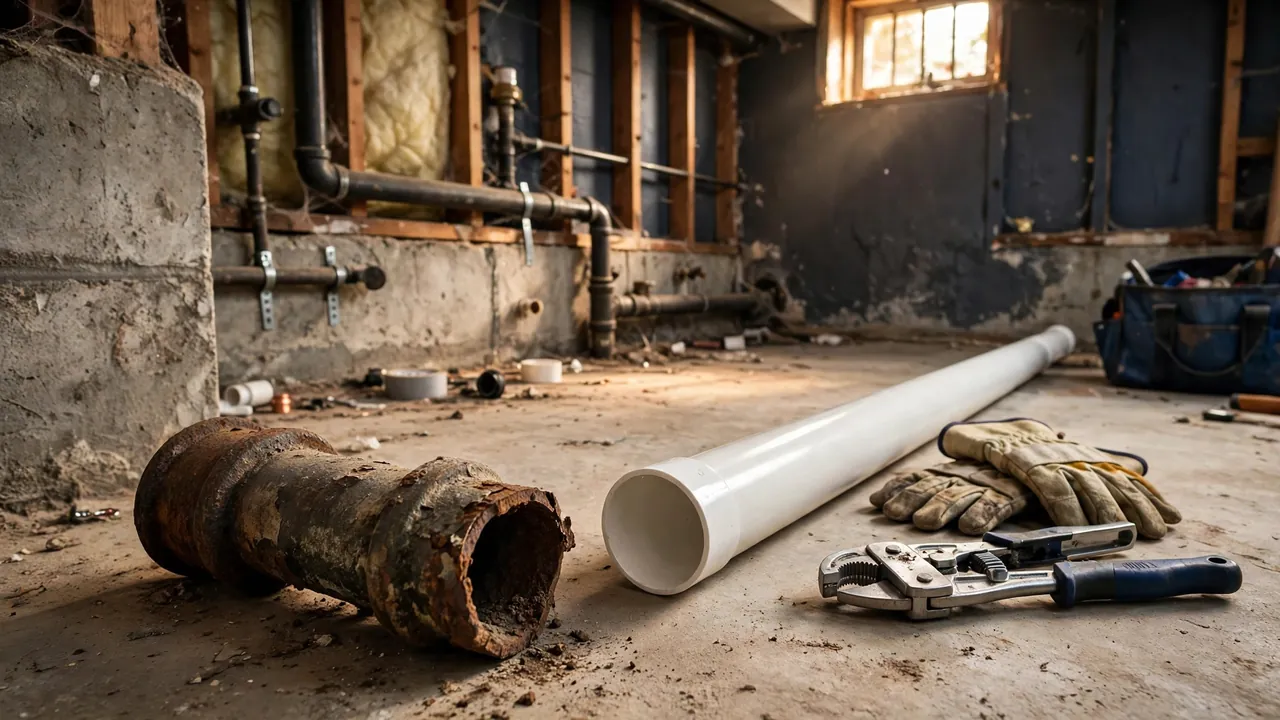
I’m Dan Reeves, a licensed master plumber with 20 years in residential work and more than 4,000 jobs behind me. If your home was built between the 1940s and the 1980s, there is a good chance its drain system is cast iron, and cast iron has a lifespan — which means millions of homeowners are on a countdown they cannot see. The good news is that iron rarely fails without warning, replacement no longer automatically means a trench through your yard, and the whole job is dramatically cheaper planned than emergency. Here is how I help homeowners read the signs, choose the method, and understand the bill.
Quick answer: Cast iron drains typically serve 25 to 50 years. Replacement costs depend on method: trenchless lining runs $80 to $250 per foot (most full jobs $8,500 to $15,000), pipe bursting is similar per foot plus access pits, and traditional dig-and-replace runs $100 to $300 per foot with totals of $10,000 to $30,000 once excavation and restoration are counted. A camera inspection, $250 to $500, is always step one.
How much does cast iron pipe replacement cost by method?
| Method | Typical cost | Yard/floor disruption | Expected life of the fix |
|---|---|---|---|
| Camera inspection (always first) | $250–$500 | None | — |
| Spot repair (one failed section) | $1,000–$4,000 | One excavation or access point | Depends on the rest of the line |
| Trenchless lining (CIPP) | $80–$250 per foot; most homes $8,500–$15,000 | Two small access points | 25–50 years |
| Pipe bursting | ~$150 per foot plus access pits | Two excavations | 50+ years (new HDPE pipe) |
| Traditional dig and replace | $100–$300 per foot; totals $10,000–$30,000 | Full trench | 50+ years (new PVC) |
| Restoration after digging | Adds $7,500–$10,000 on finished surfaces | Driveways, landscaping, floors | — |
Read the table the way I do: per-foot prices make trenchless look expensive and digging look cheap, but the dig carries an excavation bill and a restoration bill that trenchless mostly avoids. This Old House puts a conventional full sewer line replacement average around $3,320 for shorter, simpler runs — once a line runs under a slab, driveway, or mature landscaping, the full-project numbers in this table are the realistic ones. Scope is everything: how many feet, how deep, and what sits on top.
What are the signs cast iron pipe is failing?
Cast iron telegraphs its decline for years before it collapses. The signs, in roughly the order I see them escalate:
- Slow drains throughout the house, not just one fixture. Interior scale and rust tubercles narrow the bore for decades. When every drain is sluggish, the main line is the suspect.
- Recurring backups and clogs that keep coming back. A line that needs snaking twice a year is not a clog problem anymore — it is a pipe problem expressing itself as clogs. I map the pattern in signs of a main sewer line clog.
- Sewer odor in the house or yard. Cracks and failed joints let gas out where it does not belong.
- Patches of unusually lush, green, or soggy lawn along the line’s path — the line is fertilizing and watering the yard from below.
- Rust flakes and discolored water at drains, and pest activity. Open joints admit roots, soil — and worse, they give insects and rodents a highway into the house.
- Age plus any of the above. Original iron at 40-plus years with symptoms is not a coincidence. It is a diagnosis waiting for a camera to confirm it.
How does cast iron actually fail?
Two directions at once. From the inside, decades of flow carve a channel along the bottom of horizontal runs until the iron there is paper-thin or gone — channel rot — while the top of the pipe still looks fine from a cleanout. From the outside, soil moisture and acidity corrode the buried iron, faster in wet or coastal ground. Vertically, stack pipes rust at joints and develop pinhole leaks that stain walls for months before anyone connects the stain to the pipe.
This is why age-based advice fails. Florida iron under a slab in sandy, salty soil can be finished at 30 years. The same vintage of iron in a dry-soil crawlspace up north may have 20 years left. Condition is a fact you gather, not a number you guess.
What should happen before anyone quotes a replacement?
A camera inspection of the full line, recorded, with the footage reviewed alongside the quote. It typically runs $250 to $500, often credited toward the work, and it answers the only questions that matter: How much of the line is bad? Is it localized or systemic? Does the pipe still hold its shape? Where exactly are the failures, measured in feet from the cleanout?
Quotes given without a camera run are guesses wearing a uniform. The inspection also defines the method choice below — lining a pipe that has lost its bottom is money into a hole, literally, and digging up a line that could have been lined is the opposite waste. If a company pushes hydro jetting or repeated snaking as the long-term answer for structurally failing iron, get a second opinion; cleaning restores flow, it does not restore pipe.
Which replacement method fits your line: lining, bursting, or digging?
Trenchless lining (CIPP) is the workhorse for under-slab and under-yard lines that still hold their shape. We clean and descale the iron, pull in a resin-saturated felt tube, and cure it into a new pipe inside the old one. At $80 to $250 per foot and $8,500 to $15,000 for most full residential jobs, it avoids nearly all demolition and usually finishes in a day or two. Its limits are real: it cannot restore a collapsed section, it reproduces bellies, and it slightly reduces bore diameter.
Pipe bursting pulls a new HDPE pipe through the old line while fracturing the iron outward — a genuinely new pipe with no host-pipe compromise. Figure roughly $150 per foot plus the two access excavations. It handles worse pipe than lining can, upsizing is possible, and it is my pick when the iron is too far gone to line but the route is straight enough to pull.
Dig and replace is the oldest method and still the right one when the line has collapsed, lost grade, or needs rerouting. $100 to $300 per foot for the pipe work sounds moderate until excavation and the $7,500-to-$10,000 restoration of driveways, floors, and landscaping join the invoice — which is how totals reach $10,000 to $30,000. What you get for it is a brand-new PVC system with correct grade and full access to fix everything, which is why I still recommend it for the worst lines.
If your iron problem extends to the home’s supply piping as well, that is a different project with different numbers — my breakdown of the cost to repipe a house covers the supply side, and signs your house needs repiping helps you tell whether you are facing one project or two.
How long does a cast iron replacement take, and can you stay in the house?
Timeline depends entirely on method, and it is one of trenchless work’s underrated advantages. A lining job on a typical residential line usually runs one to two days: day one is cleaning, descaling, and the verification camera run; the liner goes in and cures the same day or the next, and your drains are back in service by the end of it. Pipe bursting is similar — two days is common once the access pits are dug. A traditional dig is the long pole: two to five days of open trench for a full line is normal, and the restoration of floors, driveways, and landscaping stretches past the plumbing by days or weeks.
On staying home: with trenchless work, almost everyone does. Water service interruptions are measured in hours, and most crews stage the job so you have working drains each evening. With a full excavation under a slab, expect a harder conversation — a day or two without drain service is possible, and a hotel for those nights is a legitimate line item to discuss while planning, not a surprise to absorb mid-job. Planned jobs let you schedule around all of this. Emergency jobs do not, which is the same sermon as the money: on your calendar, or on the pipe’s.
When should you call a pro about cast iron pipes?
Call when backups recur, when several drains slow down together, when sewer odor shows up, or when you are buying or selling a home with original iron — a $250-to-$500 camera inspection before closing is the cheapest negotiating information in real estate. Do not wait for the total failure: a planned trenchless job on your schedule costs a fraction of an emergency dig with sewage in the house, and it is the difference between choosing a method and accepting one. The iron under your house has been patient for forty years. Return the favor by replacing it before it stops being patient.
Frequently asked questions
How long do cast iron drain pipes actually last?
In residential drain service, 25 to 50 years is the honest range, with soil chemistry deciding where a given house lands. Cast iron in dry, neutral soil can exceed that; iron buried in wet, acidic, or coastal soil rots from the outside in and can be done at 30. The pipe also fails from the inside: decades of drain flow channel a groove along the bottom — plumbers call it channel rot — until the bottom is simply gone. Age alone is not a verdict, though. I have scoped sound 60-year-old iron and 28-year-old iron with no bottom left. The camera, not the calendar, decides.
Can cast iron pipe be repaired instead of replaced?
Sometimes, and I do it gladly when the damage is localized. A single cracked hub or one failed joint on an otherwise sound line can be cut out and replaced with a PVC section and shielded couplings for a fraction of a full replacement. What cannot be spot-repaired is systemic failure — channel rot along the run, widespread scaling that narrows the bore, or multiple offsets. Patching one break in a line that is rotting everywhere buys months, not years, and the second dig costs what the first one saved. This is why I insist on a full camera run before quoting: the repair-versus-replace answer lives in that footage.
How long does trenchless pipe lining last?
A cured-in-place liner is rated for 25 to 50 years of service by most manufacturers, and it is essentially a new plastic pipe formed inside your old one — it does not rust, root hairs cannot penetrate its joints because it has none, and its smooth bore actually flows better than the scaled iron it replaced. The honest caveats: lining slightly reduces the pipe's inside diameter, it cannot fix a collapsed or badly bellied section, and it seals over existing problems rather than removing them, so the host pipe must be cleaned and camera-verified first. Done on the right line, it is a permanent repair, not a patch.
Does homeowners insurance cover cast iron pipe replacement?
The replacement itself, almost never — aging pipe is the textbook definition of wear and tear, which standard policies exclude. What may be covered is sudden water damage the failing pipe causes: if a cast iron line lets go and floods a finished basement, the resulting damage is often a valid claim even though the pipe work is yours. Insurers in some older-home markets have also started limiting water damage coverage on houses with original cast iron, which is one more reason a proactive replacement, planned on your schedule, beats an emergency one. I cover the full rules in my guide to whether home insurance covers plumbing.
When is digging up the pipe the only real option?
I recommend open excavation when the pipe has collapsed or lost its bottom entirely — there is nothing left to line — when the line has severe bellies holding water that a liner would faithfully reproduce, when the grade itself needs correcting, or when so many branches tie in that relining would seal them shut. Digging is sometimes the economical choice on a short, shallow run with nothing above it but lawn. Trenchless methods are superb, but not magic: they rehabilitate a pipe that still has its shape. When the shape is gone, we dig, and I would rather tell you in the estimate than discover it mid-job.